Search
Close this search box.

Vulnerability study of Glacial lakes, RBI’s Financial Stability Report, Food Buffer Policy

Table of Contents
  • The Uttarakhand State Disaster Management Department (USDMA) will conduct a vulnerability study of 13 glacial lakes, five of which are in high-risk zones.
  • The study aims to provide data to help prevent calamities such as lake outbursts.
  • New lakes were identified through satellite imagery earlier this year.
  • The high-risk lakes are located in the Darma, Lasaryanghati, and Kutiyangti Valleys in the Pithoragarh district, and Vasudhara Tal Lake in the Dhauli Ganga basin in Chamoli district.

GLOF (Glacial Lake Outburst Flood)

  • A GLOF is a flood resulting from the sudden and rapid release of water from a glacial lake, often caused by the failure of a moraine dam or ice dam.
  • The primary trigger for a GLOF is the collapse or breach of a moraine dam or ice dam holding back water. This can be caused by factors such as glacial melt water, avalanches, or volcanic activity.
  • Glacial lakes are typically formed by the accumulation of meltwater from glaciers.
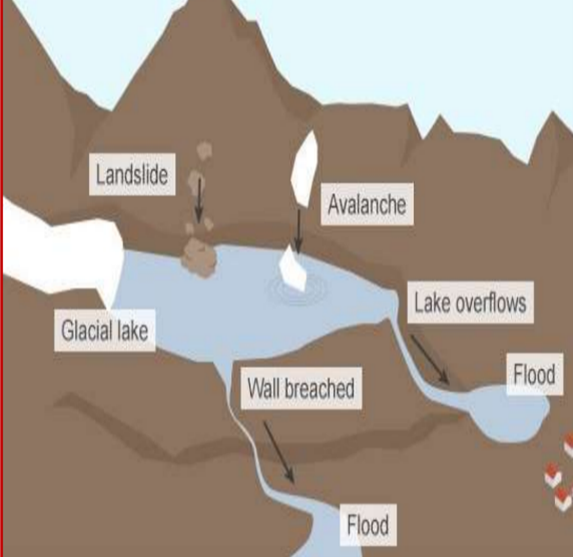
  • These lakes range from 0.02 sq. km to 0.5 sq. km in area and are situated at elevations of 4,000 meters above sea level.
  • USDMA teams will start a bathymetry study of these five potentially high-risk lakes to obtain accurate information.
  • The Indo-Tibetan Border Police shared a report on the status of these lakes.
  • After assessing the risk, the lakes will be punctured and pipes placed inside them to manage water levels.
  • Experts from the Indian Institute of Remote Sensing, the Geological Survey of India, the National Institute of Hydrology, Roorkee, the Centre for Development of Advanced Computing, and the Wadia Institute of Himalayan Geology were included in the study.

Bathymetry Study

  • Bathymetry originally referred to measuring ocean depth relative to sea level, but it now encompasses the study of underwater terrain’s depths and shapes.
  • Bathymetric Maps illustrate the underwater landscape.
  • Variations in the underwater floor relief are shown using colours and contour lines known as depth contours or isobaths.

Dig Deeper: Read about the major glacial lake outburst floods of Uttarakhand like the Kedarnath Valley flood in June 2013 and the Rishiganga Valley flood of 2021 in Chamoli.
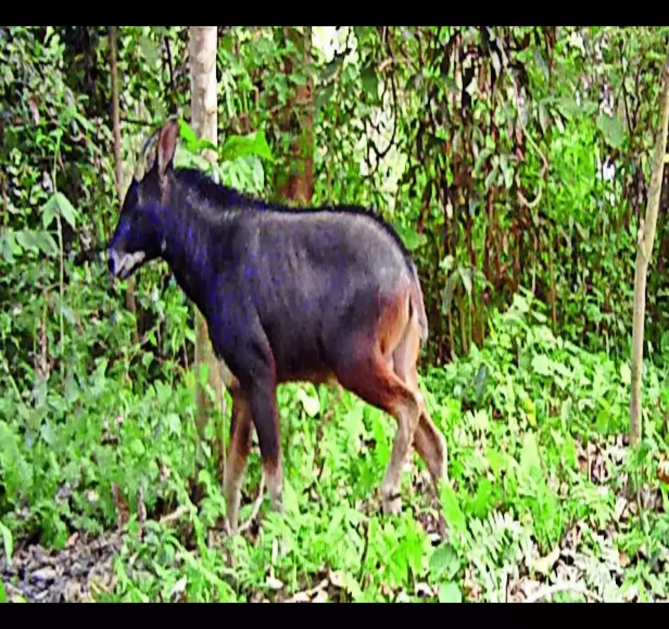
  • The mainland serow (Capricornis sumatraensis thar) is a mammal resembling a cross between a goat and an antelope.
  • Scientists recorded a lone mainland serow at 96 meters above sea level in Raimona National Park, western Assam, beyond its natural home in Bhutan.
  • This sighting marks the first time the animal has been found within 1 km of human habitation.
  • The finding, supported by photographic evidence, was published in the latest issue of the Journal of Threatened Taxa.
  • According to the International Union for Conservation of Nature, the mainland serow typically inhabits altitudes ranging from 200 to 3,000 meters.
  • IUCN Red List of Threatened Species categorises it under Vulnerable Category.
  • Its known habitat includes the Phibsoo Wildlife Sanctuary and the Royal Manas National Park in Bhutan.

Dig Deeper: List and locate all the National Parks of Assam on the map.

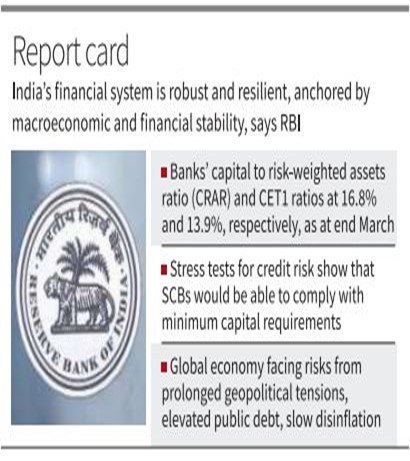
  • The Indian economy and financial system remain robust and resilient, anchored by macroeconomic and financial stability, according to the Reserve Bank of India’s (RBI) 29th Financial Stability Report (FSR).
  • The RBI highlighted that improved balance sheets of banks and financial institutions are supporting economic activity through sustained credit expansion.
  • As of end-March 2024, scheduled commercial banks (SCBs) had a capital to risk-weighted assets ratio (CRAR) of 16.8% and a common equity tier 1 (CET1) ratio of 13.9%.
  • SCBs’ gross non-performing assets (GNPA) ratio fell to a multi-year low of 2.8%, and the net non-performing assets (NNPA) ratio declined to 0.6%.
  • Macro stress tests for credit risk indicate that SCBs will comply with minimum capital requirements, with the system-level CRAR projected at 16.1%, 14.4%, and 13.0% in March 2025 under baseline, medium, and severe stress scenarios, respectively.
  • However, the RBI noted these are stringent conservative assessments under hypothetical shocks and should not be interpreted as forecasts.
  • Non-banking financial companies (NBFCs) remained healthy, with a CRAR of 26.6%, a GNPA ratio of 4.0%, and a return on assets (RoA) of 3.3% as of end-March 2024.
  • The RBI also noted that the global economy faces heightened risks from prolonged geopolitical tensions, elevated public debt, and slow progress in disinflation.
  • Despite these challenges, the global financial system has remained resilient, and financial conditions are stable.

Dig Deeper: Know about India’s Fiscal deficit and Current Account Deficit numbers along with details of FRBM act.

  • With CPI inflation for cereals touching 8.69% and 17.14% for pulses, government intervention in such a scenario has prevented runaway inflation.
  • This has reignited the debate over need for a food buffer policy in India to ensure price control.

Need for a food buffer policy –

  • Control Inflation: Open market sales of buffer stocks for wheat and chana have helped control inflation in cereals and pulses.
  • Climate Impact: Increasing climate-driven supply shocks and price volatility necessitate extending buffer stocks to other staples.

Example of Government Intervention

  • FCI offloaded 34.82 lakh tonnes (lt) of wheat in 2022-23, rising to 100.88 (lt) in 2023-24. This reduced wheat inflation from 25.37% in February 2023 to 6.53% in May 2024.
  • NAFED bought large quantities of Chana during surplus years, preventing higher inflation. Current season saw limited procurement due to high open market prices but existing stocks helped control prices.

Measures –

  • Expanded Procurement: Include more pulses, oilseeds, staple vegetables, and skimmed milk powder (SMP).
  • Storage and Sales: Store vegetables in processed forms for institutional sales; SMP can stabilize milk prices during shortages.
  • Fiscal Cost: Buffer stocks to be offloaded at near-market prices during scarcity, minimizing fiscal impact.

Thus, buffer stocking can curb excessive food price volatility, benefiting both consumers and producers. Similar to RBI’s forex reserves, a food buffer policy is crucial for managing climate-driven price instability.

Dig Deeper: Read about CPI and WPI inflation differences and various official agencies which bring out this numbers.