Search
Close this search box.

Tenure Extension of COAS, Japan and Commercial Whaling, Europe’s AI Convention

Table of Contents
  • In an unusual move, the Appointments Committee of the Cabinet, extended the tenure of the Chief of the Army Staff (COAS) by one month.
  • Normally, for service chiefs, the term of office is until the age of 62 or three years, whichever is earlier.
  • There is only one instance in the past when in 1975 was given a one-year extension.
Constitutional Provisions and Cabinet Committee on AppointmentsThe executive works under the Government of India Transaction of Business Rules, 1961.Article 77(3) of the Constitution: “The President shall make rules for the more convenient transaction of the business of the Government of India and for the allocation among Ministers of the said business.” Cabinet committees are extra-constitutional in emergenceCabinet Committee on Appointments consists of the Prime Minister and Home Minister.Appointments Committee decides all higher-level appointments in the Central Secretariat, Public Enterprises, Banks and Financial Institutions.

The Cabinet Committee approved the extension in service under Rule 16 A (4) of the Army Rules 1954.

Dig Deeper: Read about the mandate of CDS and its implications on service chiefs.
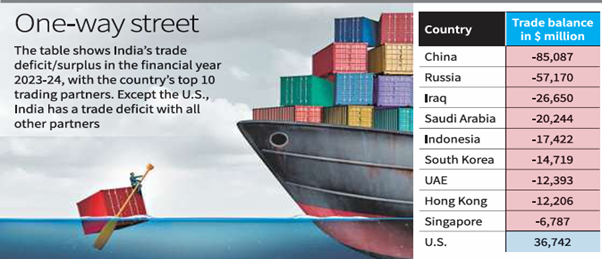
  • India has recorded a trade deficit, the difference between imports and exports, with nine of its top 10 trading partners, including China, Russia, Singapore, and Korea, in 2023-24, according to official data.
  • The data also showed that the deficit with China, Russia, Korea, and Hong Kong increased in the last fiscal compared to 2022-23, while the trade gap with the UAE, Saudi Arabia, Russia, Indonesia, and Iraq narrowed.
  • China has emerged as India’s largest trading partner with $118.4 billion of two-way commerce in 2023-24, edging past the U.S.
  • The bilateral trade between India and the U.S. stood at $118.28 billion in 2023-24. Washington was the top trading partner of New Delhi during 2021-22 and 2022-23.
  • India has a free trade agreement with four of its top trading partners — Singapore, the UAE, Korea and Indonesia (as part of the Asian bloc).
  • India has a trade surplus of $36.74 billion with the U.S. in 2023-24. America is one of the few countries with which India has a trade surplus.
  • The surplus is also there with the U.K., Belgium, Italy, France and Bangladesh.
  • India’s total trade deficit in the last fiscal narrowed to $238.3 billion as against $264.9 billion in the previous fiscal.
  • A deficit is not always bad if a country is importing raw materials. However, it puts pressure on the domestic currency. A rising trade deficit can cause the country’s currency to depreciate because more foreign currency is needed for imports.

Dig Deeper: Read about the initiatives of the Government of India to increase exports and reduce import dependency.  

  • India has increasingly been in the grip of more frequent and intense heat waves, as per a recent study published in Science Advances.
  • On average heatwaves have slowed down nearly 8 km/day each decade and lasted longer by about four days — the effects being particularly drastic in North America and Eurasia.
  • Heatwaves have also increased in frequency, from about 75 events averaged over 1979-1983 to about 98 over 2016-2020.
  • Over the years, the jet stream, a fast, narrow current of air that flows from west to east high up in the troposphere has become weaker.
  • The jet stream guides atmospheric waves, waves that are caused by the earth’s rotation and which influence the earth’s surface temperature.
  • As the jet stream weakens, these waves also move more slowly, leading to more persistent weather events, and more spells of high and slow-moving heat.
  • Along with natural climate variability and natural events, human activity and greenhouse gas emissions have also played a dominant role in rendering the slower-moving and longer-lasting heat.

Dig Deeper: What is the Heat Dome and Omega block weather phenomenon?

  • Japan’s new whaling mothership, the Kangei Maru, arrives in Tokyo, which is the country’s first domestically built whaling ship, set sail on its maiden hunting voyage, heralding a new era for the controversial practice defended by the government as an integral part of national culture.
  • The UN Convention on the Law of the Sea binds countries to cooperate on the conservation of whales through the appropriate international organisations for their conservation, management and study. Not necessarily the International Whaling Commission. 
International Whaling Commission
The IWC is responsible for setting catch limits for commercial whaling with the exceptions.  In 1982 the IWC decided that there should be a pause in commercial whaling on all whale species and populations from the 1985/1986 season onwards.  This pause is often referred to as the commercial whaling moratorium, and it remains in place today.   The moratorium is binding on members of the IWCJapan left the IWC in 2019 and began to catch whales commercially the same year. Having left the IWC is no longer bound by the moratorium.    

In recent years, Norway and Iceland have caught whales commercially.  

Dig Deeper:  What is the North Atlantic Marine Mammal Commission (NAMMCO), and who are its members?

  • In astronomy, a ‘transient’ is any celestial object whose brightness changes in short periods.
  • The Indian-American astronomer Shrinivas Kulkarni was awarded the Shaw Prize for Astronomy in 2024 for his work on the physics of astronomical transients.
  • One of the most well-known transients is supernovae.Many a supernova has been known to become so bright that it emits light more intensely than the stars in the rest of its host galaxy combined.
  • Another famous transient is the active galactic nucleus (AGN). The centres of massive galaxies host supermassive black holes which feast on matter in their orbit. Interactions between the black holes and the matter in this process cause the latter to acquire energy and glow with changing brightness.
  • In 2007, astronomers discovered a mysterious new transient called a fast radio burst (FRB), they can emit more than 10 times as much energy as the Sun in a few milliseconds.

Dig Deeper: Read more about Blackholes and Fast Radio Bursts.

  • The Pradhan Mantri Janjati Adivasi Nyaya Maha Abhiyan (PM-JANMAN) was launched in November 2023, with a budget of ₹24,000 crore.
  • The PM JANMAN seeks to provide essential services to PVTGs, which includes safe housing, clean drinking water, and sanitation through 11 critical interventions.
  • Its objective is to ensure that every PVTG household has access to secure and habitable housing, safeguarding them from environmental challenges and providing them with a sense of security.
  • Households under the scheme are entitled to receive ₹2.39 lakh each in three instalments. It aims to reach 4.90 lakh PVTG households by 2026.
PVTGs
India is home to numerous Adivasi groups, with 75 identified as Particularly Vulnerable Tribal Groups (PVTGs) across States.Odisha has the highest PVTGs followed by Andhra Pradesh.According to official data, they comprise around 14.6 lakh households. These tribes reside in scattered, remote, and often inaccessible areas, characterised by their reliance on methods and tools for their livelihood that predate the advent of agriculture, low literacy rates, economic backwardness, and stagnant populations.The Government of India announced the Pradhan Mantri PVTG Development Mission in 2023-24 to improve the socio-economic conditions of PVTGs.  

The Government of India has provided an ‘Awaas+’ mobile app to block/panchayat-level officials to register PVTG households.

  • The app gathers beneficiary data in three primary areas — it records the geographical location of households, noting their block, panchayat, and village.
  • It captures household profiles, incorporating geo-tagging for planned construction locations, and then collects bank account details for cash transfers.
  • Having a job card is mandatory for PM JANMAN Housing registration.

Dig Deeper: Read about the Dhebar Commission and Identification of PVTGs.

  • The Council of Europe (COE) took a big step by adopting the Framework Convention on Artificial Intelligence and Human Rights, Democracy and the Rule of Law — also known as the ‘AI convention’.
  • The COE is an intergovernmental organisation formed in 1949, with 46 members today, including the Holy See, Japan, and the U.S., plus countries of the EU bloc and others.
  • The agreement is a comprehensive convention covering AI governance and links to human rights, democracy, and the responsible use of AI.
  • The framework convention will be opened for signature in Vilnius, in Lithuania, on September 5.
  • A ‘framework convention’ is a legally binding treaty that specifies the broader commitments and objectives under the Convention, and sets mechanisms.
  • In future, there may be a ‘Protocol on AI Risk’ under Europe’s AI convention.
Definition of AI
Article 1 of the convention states aims to ensure artificial intelligence systems are fully consistent with human rights, democracy and the rule of law.The definition of AI is similar to the one in the EU AI Act, which is based on the OECD’s definition of AI: “An AI system is a machine-based system that, for explicit or implicit objectives, infers, from the input it receives, how to generate outputs such as predictions, content, recommendations, or decisions that can influence physical or virtual environments.”While disinformation and deep fakes haven’t been addressed specifically in the framework. 

The AI convention doesn’t create new and/or substantive human rights specific to AI. Instead, it asserts that existing human and fundamental rights are protected.

Dig Deeper: Read about India’s initiative the IndiaAI Mission.