Search
Close this search box.

Srinagar-World Craft City, Maternity Leaves in Surrogacy, People’s Climate Vote Survey, 2024 – UNDP

Table of Contents
  • The Kerala Assembly, in a unanimous decision, passed a resolution proposing a Constitutional amendment to change the name of the State to ‘Keralam’ (similar attempts were made in 2010 also).
  • The resolution, moved by the Chief Minister, called for invoking Article 3 of the Constitution to effectuate this change in the First Schedule.
  • This resolution mirrors an attempt from last year, which was sent back by the Centre due to procedural issues.

Article 3

Article 3 spells out the modes/ways of formation of States in the country. The modes so spelt out are

  • by separation of territory from any State (ii) by uniting two or more States or parts of States or
  • by uniting any territory to a part of any State.
  • And all the aspects that are included in the process are as follows:

(a) increase in the area of any State or

(b) reduction in the area of any State or

(c) alteration in the boundary or

(d) name of any State.

  • The renaming of a state requires Parliamentary approval under Articles 3 and 4 of the Constitution, and the President has to refer the same to the relevant state legislature for its views.
  • Parliament can change the name of a state by law. A Bill for this can only be introduced in Parliament with the President’s prior recommendation, which is given after obtaining the State Legislature’s views.
  • The State Legislature’s views are not binding on the President.
  • Parliament can amend the Bill after referring it to the State Legislature for their views, without needing to refer the amendment back to the State Legislature.
  • Article 4 states that laws made by Parliament under Articles 2 and 3, affecting the First or Fourth Schedule and related matters, are not considered constitutional amendments under Article 368.

Dig Deeper: Read about procedure to change the name of the Official language of the state
  • Srinagar has earned the World Craft City tag from the World Crafts Council (WCC), a non-government organisation working to empower artisans and safeguard craft heritage globally.
  • The Indian National Trust for Art and Cultural Heritage-Kashmir (INTACH-K), described the honour as the latest recognition of the skill base of Kashmir.
  • This will provide a boost to Kashmir’s traditional linkages with Central Asia and Iran.
  • Mamallapuram, Jaipur and Mysore are other Indian cities with the World Craft City tag.

Crafts of Srinagar

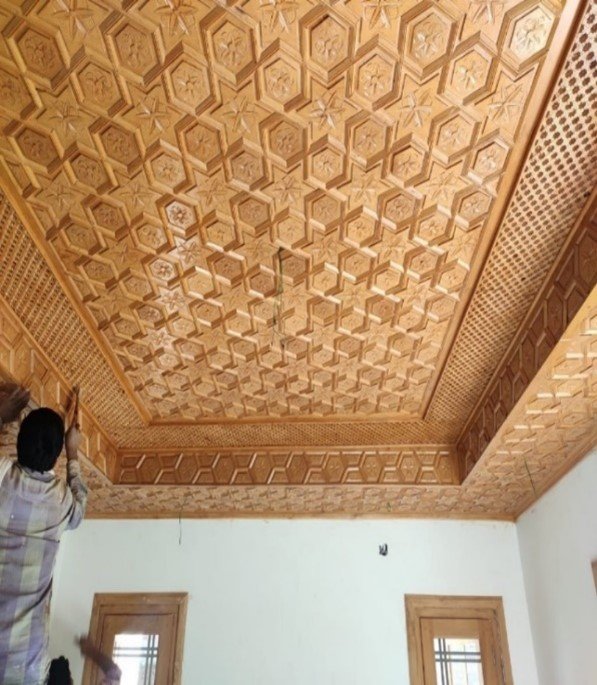
Srinagar, a historic city on the ancient Silk Route, has a rich legacy in arts and crafts. Pashmina Shawls, Kani Shawls, Kashmiri Sozni Embroidery, Kashmiri Hand-Knotted Carpets, Papier-Mâché, Walnut Wood Carving, Khatamband have GI Tags.

  1. Papier-Mâché: Art made from molded paper pulp, traditionally painted and lacquered, reflecting Kashmir’s landscape.
  2. Kashmiri Carpets: Hand-knotted carpets, dating back to the 14th century, known for intricate designs and the unique Taleem script.
  3. Pashmina Shawls (Kani, Sozni): Renowned for their quality, Pashmina shawls became fashionable in Europe by the 17th century. Kani shawls use a wooden piece for weaving, while Sozni embroidery features intricate needlework with local motifs.

The World Crafts Council

  • It is a non-profit organisation founded in New York in 1964.
  • The Presidency changes every four years, with the current headquarters in Kuwait.
  • Celebrating its 60th anniversary in 2024, the Council reaches millions of craftsmen, artisans, and craft communities across the world.
  • It has been affiliated with UNESCO under Consultative Status.
  • The Council aims to strengthen the status of crafts in cultural and economic life.

Dig Deeper: Read about UNESCO’s Creative Cities Network and the Indian cities listed under it.

  • The Centre has notified amended Central Civil Services (Leave) Rules, 1972 allowing women government employees to take maternity leave if they have children through surrogacy.
  • The changes are compared in the below table.
Previous RulesAmended Rules
No maternity leave provision for women government employees in case of surrogacy.Women government employees can take 180 days of maternity leave for children born through surrogacy.
No rules for paternity leave in case of surrogacy.Commissioning fathers (intending fathers) can take 15 days of paternity leave within six months from the date of delivery of the child.
Childcare leave provisions not specified for surrogacy cases.Commissioning mothers with fewer than two surviving children may be granted childcare leave.
Existing rules allow female government servants and single male government servants to take child care leave for a maximum period of 730 days during the entire service.Commissioning mothers and fathers, under the same conditions, are eligible for the new maternity and paternity leave benefits.
Surrogacy-related terms not defined.“Surrogate mother” is defined as the woman bearing the child on behalf of the commissioning mother. “Commissioning father” is defined as the intending father of the child born through surrogacy.
  • In India, under the Maternity Benefit (Amendment) Act, 2017, private sector women employees are entitled to 26 weeks of paid maternity leave for the first two children, and 12 weeks for subsequent children.
  • Adoption and surrogacy mothers receive 12 weeks. Up to 8 weeks can be taken pre-delivery.
  • Establishments with 50+ employees must provide creche facilities, with women allowed four daily visits.
  • Employees can also opt for work-from-home post-leave.
  • Women are protected from dismissal due to maternity and are entitled to return to the same or a similar position. A medical bonus of Rs. 3,500 is provided if pre/post-natal care isn’t offered.

Dig Deeper: Read about the Journey of The First 1000 Days (Foundation for a Brighter Future) report highlights.

  • Around 77% of Indians want stronger climate commitments, according to the 2024 People’s Climate Vote survey by the UNDP, University of Oxford, and GeoPoll.
  • In India, 33% think about climate change daily, and over half are more worried than last year, but only 26% believe India is addressing it well.
  • The survey follows a severe heat wave in north and central India.
  • The Peoples’ Climate Vote is the world’s largest public opinion survey on climate change, offering a platform for global citizens to share their views with world leaders.
  • The 2024 survey expanded to 77 countries, covering 87% of the global population.

Dig Deeper: List the important global reports published by UNDP.

About Great Nicobar

  • Great Nicobar, the southernmost tip of India, is part of the Andaman and Nicobar archipelago comprising around 600 islands.
  • It is the largest of the Nicobar Islands, characterized by lush rainforests, diverse wildlife, and a unique ecosystem.
  • The island is home to the Shompen and Nicobarese tribal communities.
  • The Shompen, around 250 individuals, are hunter-gatherers living in the interior forests.
  • The Nicobarese, about 1,300 in total, practice farming and fishing.
  • The island also hosts around 6,000 settlers from mainland India.
  • The opposition has demanded an immediate suspension of all clearances for NITI Aayog’s mega project on Great Nicobar Island.
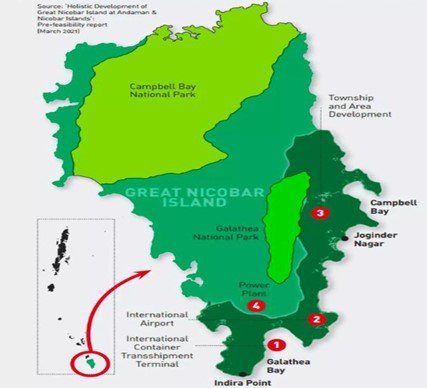
  • In March 2021, NITI Aayog unveiled a ₹72,000 crore plan for the holistic development of Great Nicobar Island, including an international trans-shipment terminal, an international airport, a power plant, and a township.
  • The project aims to integrate Great Nicobar into the regional and global maritime economy and promote sustainable tourism.
  • Concerns associated with the project:
  • Great Nicobar Project will cut around 1 million trees for infrastructure development on Great Nicobar Island.
  • It requires the diversion of 130 sq km of forest land.
  • Compensatory afforestation will occur in Haryana due to limited plantation scope in the Andaman and Nicobar Islands, a decision criticized by environmentalists.
  • The Tribal Council of Great Nicobar and Little Nicobar have voiced their opposition.
  • The trans-shipment terminal is planned for Galathea Bay, a crucial nesting site for the endangered giant leatherback turtle.
  • The project also threatens the ancestral lands of the Great Nicobarese and poses health risks to the Shompen due to their lack of immunity to common diseases.
  • The local panchayat of Campbell Bay and disaster management researchers have raised concerns over the social impact assessment process for land acquisition and the failure to adequately assess earthquake risks in this seismically active region.

Dig Deeper: Locate important choke points of Indo-Pacific Trade routes on the map.