Search
Close this search box.

Sittwe Port, Snake Mon, Annual Survey of Unincorporated Sector Enterprises (ASUSE) of NSSO

Table of Contents
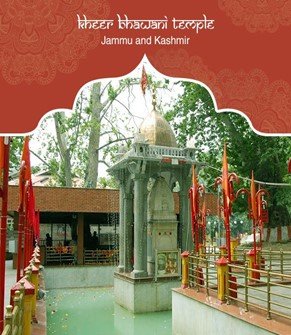
  • Thousands of Kashmiri Pandits converged at the Kheer Bhawani temple in Kashmir Valley’s Tul Mulla in Ganderbal district to attend the annual festival of Zyestha Ashtami.
  • Many of them had migrated to different parts of the country in the 1990s in the wake of raging militancy.
  • This time the water is ‘Nirmal’ (clean and transparent), which is considered a good omen.
  • The temple of Kheer Bhawani is located amid chinar trees and has a natural spring, which is considered auspicious by Pandits.
  • The mention of Kheer Bhawani is found in Kalhana’s Rajtarangini. Kalhana writes that the sacred spring of Tula Mula is situated in a marshy ground.
  • Kheer Bhawani temple is dedicated to the goddess Mata Maharagina Bhagwati.
  • Legend is that Mata Maharagina was pleased with the devotion of Ravna who appeared before him and he got the image of the Goddess installed in Sri Lanka.
  • However, the Goddess became displeased with the vicious life of Ravna and did not want to stay in Sri Lanka.
  • Therefore, she is believed to have instructed Lord Hanuman to get the image from Sri Lanka and install it at the holy spot of Tul Mulla.

Dig Deeper: Locate on the map various pilgrimage sites in the union territory of Jammu and Kashmir.
  • Myanmar’s junta has ordered thousands of people living outside the Rakhine state capital Sittwe, to vacate their homes and head into the city.  
  • Sittwe city is one of the few holdouts for junta troops in western Rakhine state, where the Arakan Army (AA) has taken over large territory.
  • The AA is said to be fighting for autonomy for the state’s ethnic Rakhine population and has vowed to capture Sittwe, home to an India-backed deep-sea port and around 2,00,000 people.
  • After Chabahar, India has gained the right to operate a second overseas port, Sittwe, in Myanmar.
  • The Ministry of External Affairs (MEA) has approved a proposal for India Ports Global (IPGL) to take over the operations of the entire port located on the Kaladan River.
  • IPGL is a company 100 per cent owned by the Ministry of Ports, Shipping and Waterways.
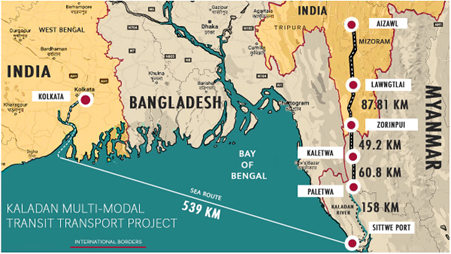
  • The Sittwe Port, situated in Myanmar’s Rakhine State, is a vital element of the Kaladan multi-modal transit transport project.
  • This deep-water port enhances connectivity by facilitating cargo movement from Vizag and Kolkata to the Northeastern states of India, bypassing Bangladesh.
  • Additionally, it alleviates reliance on the Siliguri Corridor, a narrow passage between Bhutan and Bangladesh.
  • In the Indian Ocean, China and India are engaged in a struggle to expand their economic influence. Ports have become highly significant in this rivalry.
  • India’s operational control over Sittwe and Chabahar ports bolsters its maritime influence, serving as a strategic counter to China’s String of Pearls strategy, which includes ports like Hambantota in Sri Lanka and Djibouti in Africa.

Dig Deeper: Locate India’s similar initiatives in Oman, Singapore and Indonesia on the map.

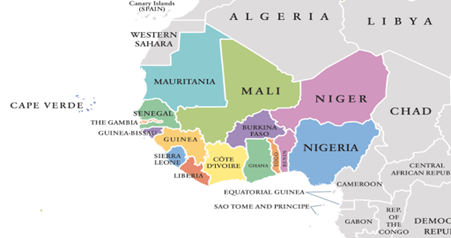
  • Thousands of fishermen fill a large muddy pond and cast their nets in the southern Mali town of San, for Snake Mon, a collective fishing ritual.
  • For several hundred years, people have gathered for the event, which is on UNESCO’s list of intangible cultural heritage.
  • The marathon session of collective fishing celebrates the town’s founding and marks the beginning of the rainy season.
  • Climate change and heat waves are disturbing the tradition. Heat waves in Mali in recent years have caused the pond to start drying out.
  • Temperatures in the town have reached a record this year at 48.5 degrees Celsius (119 degrees Fahrenheit)

Dig Deeper: Read about India’s Intangible cultural heritage traditions on the UNESCO list.

  • In the icy waters of the Arctic, NATO scientists are studying sound waves to improve the tracking of Russian submarines as global warming alters underwater acoustics.
  • Acoustic waves are the only reliable source of information for tracking submarines.
  • Instruments will measure water temperature, salinity, and pressure, affecting sound speed in water.

Acoustic Waves

  • Ocean acoustics is the study of sound and its behaviour in the sea.
  • When underwater objects vibrate, they create sound-pressure waves that alternately compress and decompress the water molecules as the sound wave travels through the sea.
  • Sound waves radiate in all directions away from the source like ripples on the surface of a pond.
  • The compressions and decompressions associated with sound waves are detected as changes in pressure by the structures in our ears and most man-made sound receptors such as a hydrophone, or underwater microphone.
  • The melting sea ice alters the Arctic’s soundscape, with increasing human presence and cracking ice.
  • The data is crucial for developing sonars and autonomous underwater vehicles (AUVs), identifying surface vessels by propeller sounds, and facilitating minesweeping.
  • Strict rules protect the Arctic’s ecosystem. Work halts if animals are detected.
  • The Russian navy, with significant capabilities and the powerful Northern Fleet, poses a threat in the Arctic, home to numerous submarines with nuclear warheads.

Dig Deeper: Read about the Arctic Council.

  • The Annual Survey of Unincorporated Sector Enterprises (ASUSE) conducted by the National Sample Survey Office (NSSO) in 2021-22 and 2022-23 is released recently.
  • According to the annual factsheet the second wave of the COVID-19 pandemic badly hit India’s large informal non-agricultural sector.
  • It has recovered gradually since then, with the number of unincorporated firms and their employees rising almost 6% and 8%, respectively, by the latter half of 2022-23.
  • Gross Value Added (GVA) by such enterprises grew by 9.83% at current prices during the period October 2022 and March 2023, in comparison with the financial year 2021-22.
  • Between October 2022 and March 2023, the number of estimated informal firms had risen to 6.5 crore with 11 crore employees.
  • This 7.84% annual growth in jobs demonstrates the sector’s capacity to generate employment.
  • The survey data, released by the Statistics Ministry is used in compiling national account statistics as the country’s unincorporated non-farm sector plays a key role in generating jobs, creating economic value and the overall socio-economic landscape.

Dig Deeper: Read about various surveys and statistics released by NSSO.