Search
Close this search box.

Red Flag, Virus-like Particles (VLPs) of Nipah, Floods in Assam

Table of Contents
  • The Indian Air Force (IAF) is taking part in a mega multinational exercise Red Flag 24 hosted by the U.S.
  • An IAF contingent arrived at the Eielson AF Base of the U.S. Air Force, in Alaska to participate in the upcoming edition of the multi-national exercise Red Flag 24.
  • The IAF has deployed Rafale fighter jets supported by its IL-78 air-to-air refuellers and the C-17 transport aircraft.
  • Red Flag is a two-week advanced aerial combat training exercise.  It is designed to provide realistic training in a simulated combat environment.

RIMPACK

  • The Indian Navy is deploying the indigenous stealth frigate INS Shivalik for Exercise RIMPAC (Rim of the Pacific) scheduled to be held in Hawaii.
  • INS Shivalik departed to Yokosuka, Japan to participate in the Japan-India maritime exercise JIMEX-24 and then onward to RIMPAC-24.
  • It is aimed at enhancing the degree of interoperability with the Japan Maritime Self Defence Force, U.S. Navy and other partner navies participating in RIMPAC 24.

Dig Deeper: Read about India’s multinational exercises like Vayu Shakti- 2024 and Gaganshakti- 2024 
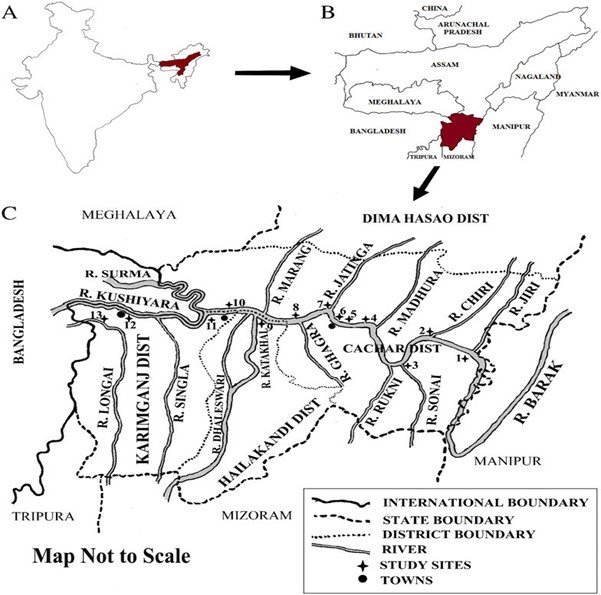
  • The flood situation in Assam remained worst with more than six lakh people in 10 districts reeling under water.
  • The Kopili, Barak and Kushiyara rivers were flowing over the danger level.
  • The Barak River flows through the states of ManipurMizoram and Assam in India.
  • It flows into Bangladesh where it bifurcates and converges again to become the Meghna River before forming the Ganges Delta.
  • The Katakhal, Jiri, Chiri, Modhura, Longai, Sonai, Rukni and Singla are the main tributaries of the Barak.
  • The tributaries are mainly rain-fed and cause flood problems when precipitation occurs.
  • Kopili flows through the states of Meghalaya and Assam and is the largest south-bank tributary of the Brahmaputra in Assam.
  • Kushiyara River a distributary of the Barak River flows through Assam, and then on to Bangladesh.
  • India-Bangladesh signed the first water-sharing agreement of the Kushiyara River since the landmark Ganga Waters Treaty in 1996.

Dig Deeper: Read about seismogenic liquefaction features identified in the Kopili fault zone.

  • Scientists at the Institute of Advanced Virology (IAV) at Thonnakkal have developed a novel way of generating non-infectious Nipah virus-like particles (VLPs) in the laboratory, which mimic the wild-type Nipah Virus (NiV).
  • It offers a safe and effective alternative platform for developing neutralising antibodies against the NiV in a biosafety level-2 (BSL) laboratory.
  • One step closer to developing monoclonal antibodies and anti-virals against the NiV and similar pathogens.
  • The zoonotic virus Nipah is a highly pathogenic paramyxovirus, with a fatality rate of up to 80% in affected humans.
  • Research studies have been limited because of the extreme level of biosafety precautions required for handling this BSL-4 pathogen.
  • Virus neutralisation is critical for the development and evaluation of vaccines and immunotherapeutics, and for conducting basic research into the immune response and pathogenesis of NiV.
  • It removed the requirement of high-security labs.

Virus-Like Particles (VLPs)

  • The VLPs closely resemble viruses, but are non-infectious.
  • Effective quantitative platform for studying viral binding and entry kinetics of the virus.
  • The advent of NanoBiT technology and “HiBiT-tagged” VLP (HiBiT is an 11 amino acid peptide) makes it sophisticated.
  • The genome of the NiV encodes 6 major proteins: glycoprotein (G), fusion protein (F), matrix (M), nucleocapsid (N), long polymerase (L) and phosphoprotein (P).
  • It used plasmid-based expression systems encoding the structural protein G, F, and M.

Dig Deeper: What is the difference between a virus and a viroid?

  • A small, seemingly unremarkable fern that only grows on the remote Pacific Island of New Caledonia, a French Pacific territory that has recently seen unrest.
  • It is crowned as the record-holder for having the largest genome of any organism on the earth.
  • The New Caledonian fern (Tmesipteris oblanceolata) has more than 50 times more DNA packed into the nucleus of its cells than humans.
  • It is seven per cent larger than the previous record holder, the Japanese flowering plant Paris japonica.
  • Plants have the biggest genomes; they can also have incredibly small ones.
  • The more DNA you have, the larger your cells need to be to squeeze it all in.
  • For plants, bigger cells mean things like the pores of leaves have to be larger, which can make them grow more slowly. It is also trickier to make new copies of all that DNA, limiting their reproductive abilities.

Genome

  • Humans are estimated to have more than 30 trillion cells in our bodies.
  • Within each of those cells is a nucleus that contains DNA, which is like a book of instructions that tells an organism like ourselves how to live and survive.
  • All of an organism’s DNA is called its genome.
  • Among animals, the marbled lungfish has the largest.

Dig Deeper: What is the difference between gene and genome?

  • Hunga Tonga Volcano erupted in the Pacific Kingdom of Tonga and created a tsunami and sent sound waves globally multiple times.
  • A recently published climate impact study in the Journal of Climate noted below observations:
  • The eruption can explain the large ozone hole in 2023 and the wetter-than-expected summer of 2024.
  • Sulfur dioxide in smoke clouds cools the earth by creating sulfate aerosols that reflect sunlight. However, Hunga Tonga produced little smoke but released 100–150 million tonnes of water vapour.
  • This water vapour reached the stratosphere (15-40 km above the surface) and contributed to chemical reactions that destroyed the ozone layer.
  • Water vapour also acts as a potent greenhouse gas. However, it had a minimal impact on global mean temperatures (0.015°C).
  • Northern Australia may experience colder, wetter winters until 2029 and North America will have warmer winters, whereas colder winters in Scandinavia.

Dig Deeper: Locate on the map the recent volcanic eruption sites.