Search
Close this search box.

Katchatheevu Island, Coal Scam, Energy News

Table of Contents

(General Studies II – Governance Section – Government Policies and Interventions for Development in various sectors and Issues arising out of their Design and Implementation.
General Studies III – Science and Technology Section – Developments and their Applications and Effects in Everyday Life; Indigenization of Technology and Developing New Technology.)

  • The emergence of Generative AI has democratized artificial intelligence technology, offering significant benefits to individuals and businesses. However, this accessibility comes with a host of legal and social challenges.
  • As India strives to establish a comprehensive AI regulatory framework, it faces a complex landscape of challenges and opportunities that require careful navigation and strategic planning.

India’s journey towards effective AI governance is marked by several critical challenges:

1. AI-Enabled Harms and Security Threats

  • The risks associated with AI span multiple levels:
  • Hardware vulnerabilities in physical infrastructure
  • Foundational model issues, including data poisoning and consent concerns
  • Application-level risks to sensitive information and potential misuse

2. Responsibility and Accountability

  • The widespread availability of AI complicates the assignment of liability, necessitating refinements to existing legislation like the Digital Personal Data Protection Act 2023.

3. AGI Unpredictability

  • The development of Artificial General Intelligence (AGI) introduces further complexity in regulation due to its unpredictable nature.

4. Adapting Existing Legal Frameworks

  • Rather than creating entirely new laws, India’s approach involves updating existing legislation to address AI-specific issues. Key frameworks include:
  • Digital Personal Data Protection Act
  • Information Technology Act
  • Criminal Procedure Code

The K Puttaswamy vs. Union of India judgment underscores the importance of robust data privacy protections in this evolving landscape.

Strengthening India’s AI Ecosystem: A Multi-Pronged Approach –

To bolster its AI ecosystem, India must focus on supporting five key pillars:

  1. Academia: Integrating AI into curricula and promoting research aligned with national goals
  2. Startups: Providing incentives for indigenous AI development
  3. Policymakers and Government Institutions: Enhancing AI literacy and identifying suitable regulatory bodies
  4. Multinational Corporations: Incorporating their perspectives into regulatory frameworks
  5. Public-Private Partnerships: Facilitating AI governance through collaborative efforts

Addressing Specific Challenges in AI Governance:

  1. Safe Harbor and Liability Fixation: Applying existing intermediary liability protections to Generative AI tools remains challenging, as their classification as intermediaries or conduits is debated.
  2. Copyright Conundrum: The Indian Copyright Act of 1957 requires revision to address AI-generated works, co-authorship definitions, and infringement responsibility.
  3. Data Rights and Responsibilities: The introduction of the “right to erasure” and “right to be forgotten” in the DPDP Act raises questions about control over personal information embedded in AI models.

Recommendations for Effective AI Governance:

  1. Education and Awareness: Implement comprehensive campaigns involving government, media, private sector, and civil society.
  2. Human Oversight: Maintain checks and balances through human intervention in AI systems.
  3. Nodal Agency for AI Licensing: Establish a dedicated agency to oversee AI technology and service provider licensing.
  4. Collaborative Efforts: Foster partnerships among government, academia, tech firms, and civil society organizations.
  5. Balanced Regulations: Avoid stifling innovation while ensuring adequate safeguards.
  6. Learning by Doing: Consider a sandbox approach, granting temporary immunity to gather data and identify legal issues.
  7. Data Acquisition Overhaul: Ensure legal compliance and fair compensation in data collection for AI training.
  8. Centralized Data Licensing Platforms: Streamline access to necessary data while addressing historical biases.

India’s approach to AI governance must strike a delicate balance between maximizing technological benefits and safeguarding individual rights and data protection. As the country navigates the complex terrain of Generative AI governance, it must undertake a comprehensive re-evaluation of its digital jurisprudence. The path forward demands flexibility, foresight, and a commitment to ethical AI practices that will shape the future of technology in the country and beyond.

Dig Deeper: Know about technical aspects of LLMs and AI technology, along with basics of machine learning.
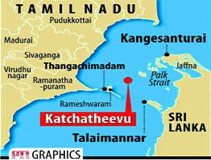
Concerns of Fisherman

  • Fisherfolk of the two countries have been traditionally using the islet for fishing.
  • Though this feature was acknowledged in the 1974 agreement, the supplemental pact in March 1976 made it clear that fishing vessels and fishermen of the two countries “shall not engage” in fishing in the historic waters, territorial sea and exclusive zone or exclusive economic zone of either of the countries “without the express permission of Sri Lanka or India.”
  • St. Anthony’s Church there holds an annual festival, either in February or March, drawing devotees from both sides of the Palk Bay, a tradition which has been going on.
  • Tamil Nadu Chief Minister rejected the claim of an agreement between the Union and State governments over ceding Katchatheevu to Sri Lanka.
  • The Katchatheevu issue originated in 1974 from an understanding between the then Union and Tamil Nadu governments.
  • Tamil Nadu government asserted that the State government was not properly consulted and that the Union government ceded the island to Sri Lanka, jeopardizing the rights and interests of Indian fishermen.
  • Katchatheevu is a small strip of land spanning about 1.9 sq. km (0.7 so miles) and is located in the Palk Strait, which separates India and Sri Lanka.
  • It lies northeast of Rameswaram in Tamil Nadu, India, and southwest of Jaffna, Sri Lanka and has no drinking water source.
  • Since 1921, both India and Sri Lanka, claimed fishing rights in the waters around Katchatheevu.
  • In June 1974, India formally exchanged agreement with her Sri Lankan counterpart ceding Katchatheevu to Sri Lanka.

Dig Deeper: Read about the Berubari case and dispute which involved the resemblance of the Katchatheevu case.

  • External Affairs Minister to participate in Council of Heads of State summit in Astana, Kazakhstan.
  • The next SCO Heads of Government meeting is scheduled in Pakistan later this year, and the 2025 SCO Summit will be hosted by China.
  • The SCO Council will adopt the Astana Declaration, focusing on economic issues, connectivity, fighting terrorism, and regional developments.
  • During the SCO Foreign Ministers meeting in May, the MEA promoted the utilization of the Chabahar Port, the International North-South Transport Corridor (INSTC), and the India-Middle East-Europe Economic Corridor (IMEC), which has been stalled due to the Israel-Gaza conflict.
  • Pakistan is expected to offer Qasim port and Gwadar port for Central Asia’s trade routes.

SCO

  • Founded in June 2001, in Shanghai, includes Kazakhstan, China, Kyrgyzstan, Russia, Tajikistan, and Uzbekistan. India and Pakistan joined in 2017, and Iran became a full member in 2023.
  • The SCO operates under the “Shanghai spirit” of mutual trust, benefit, and development.
  • Key decision-making bodies include the Council of Heads of State and Government. Its Secretariat is in Beijing, and RATS (Regional Anti- terrorist Structure) is in Tashkent.
  • Official languages are Russian and Chinese.
  • India and Pakistan, both SCO members since 2017, have often sparred over terrorism and transit trade issues. Developments in Afghanistan will also be discussed, given the SCO members’ engagement with the Taliban regime.

Dig Deeper: Read about the various China-led international organisations established to create alternatives to the leadership of the West.

  • The Tamil Nadu government has approved an investigation into allegations of a multi-crore coal import scam involving the Adani Group and others.
  • The Directorate of Vigilance and Anti-Corruption (DVAC) has initiated a preliminary inquiry into allegations of irregularities in tender conditions and coal imports, causing significant losses to the state government.
  • The sanction to DVAC was accorded under provisions of Section 17A of the Prevention of Corruption Act, 1988
  • This investigation is based on a complaint by Arappor Iyakkam, an organization advocating for transparency in governance.
  • Evidence suggested that tender conditions were altered post-2011 to favour certain firms, including Adani.
  • The Comptroller and Auditor General (CAG) found that turnover requirements for tenders were increased significantly, benefiting a select few firms.
  • It was also alleged that tenders were awarded at inflated prices, with proof from the Indonesian government confirming market rates.
  • Poor quality coal imports further led to inefficient power generation and additional losses.

Dig Deeper: Read about the mandate of the Directorate of Vigilance and Anti-Corruption and its correspondent organisation at the central level.

Stealth aircraft

  • These are designed to evade detection by radar and sensors, enhancing their survivability.
  • They use angular shapes to deflect radar waves, radar-absorbent materials to reduce reflections, and advanced cooling systems to lower infrared emissions.
  • Noise reduction techniques and controlled electronic emissions further decrease detectability. Examples include the F-22 Raptor, F-35 Lightning II, and B-2 Spirit bomber.
  • As the project for the design and development of the indigenous fifth-generation fighter aircraft, Advanced Medium Combat Aircraft (AMCA), progresses, the Defence Ministry is planning significant private sector involvement for timely execution.
  • The prototype is expected by 2028-29, with production starting in 2032-33 and induction targeted for 2034.
  • The AMCA design is complete, and a model for private sector involvement will be finalized in the next six months.
  • The Defence Ministry has issued an Expression of Interest (EOI), receiving three responses.
  • The AMCA project, sanctioned by the Cabinet Committee on Security (CCS) in March, is a 25-tonne twin-engine stealth aircraft with internal and external payload capacities and internal fuel storage of 6,500 kg.
  • Hindustan Aeronautics Limited (HAL) has already initiated manufacturing activities.
  • The AMCA project is particularly critical as it is India’s only FGFA that is planned for induction at a time when a series of such FGFA development projects is making progress worldwide.
  • China, which has made great progress in the development and deployment of FGFAs, has recently deployed its twin-engine J-20 FGFA in Tibet bordering India.

Dig Deeper: What is the difference between fifth-generation and fourth or 4.5th-generation Fighter jets?

  • Crude Oil-
  • India’s crude oil imports from Russia surged to 1.97 million barrels per day (mbpd) in June, the highest since July 2023, due to reduced shipments to China, according to Vortexa data.
  • This marks a 15% month-on-month (m-o-m) increase and a 2% annual rise. Both public and private refiners imported record quantities.
  • Public refiners, including IOCL, BPCL, and HPCL, imported a 12-month high.
  • However, imports from traditional suppliers like Iraq and Saudi Arabia declined.
  • Crude oil imports from the U.S. increased for the second consecutive month.
  • Coking Coal:
  • The Steel Ministry is diversifying its coking coal sourcing, identifying Russia and Mongolia as key new markets.
  • Plans are underway to establish a domestic mechanism for determining coking coal prices and creating an index.
  • As the world’s second-largest steelmaker and the largest importer of coking coal, India currently sources 70% of its supplies from Australia.
  • There are plans to trial two shipments of coking coal from Mongolia over the next three to six months via the Trans-Siberian-Mongolian railway.
  • The ‘one nation, one buying’ approach for coking coal, similar to Japan and China, is under consideration.

Dig Deeper: Locate on a map India’s coalfields of Coking coal.