Search
Close this search box.

Hydrogen Line, Litigotiation, Greater Adjutant Stork

Table of Contents
  • The hydrogen line, discovered in 1951, revolutionised radio astronomy. It is used for studying distant stars and searching for extraterrestrial intelligence.
  • The hydrogen atom is composed of one proton and one electron. Both particles have a property called spin, which can be up or down.
  • Spins can be aligned (up or down) or anti-aligned (opposite directions).
  • Energy States and Emissions:
  • The atom sheds excess energy when the electron flips its spin, emitting electromagnetic radiation with a wavelength of 21 cm.
  • This emission appears as a characteristic line in detectors, known as the hydrogen line.
  • Significance in Astronomy:
  • Enabled the detection of cold, neutral hydrogen atomic gas clouds in interstellar space.
  • Allowed the creation of the first map of the Milky Way galaxy, revealing its spiral arms.
  • It holds the potential for sending information across space that an alien civilization might detect.
  • The Rosette Nebula, a large hydrogen, sulphur, and oxygen gas cloud in the constellation of Monoceros, is 5,200 light years away from Earth and can be studied using this emission.

Dig Deeper: What is SETI (Search for Extraterrestrial Intelligence)?
  • Quicklime is spread over dead fish to reduce the stench.
  • Quicklime, composed of calcium (Ca) and oxygen (O), is a white or greyish-white solid. It is produced by roasting calcium carbonate (CaCO₃) to drive off carbon dioxide (CO₂).
  • It absorbs CO₂ from the air at room temperature, reversing its formation process.
  • It reacts with water to form calcium hydroxide (Ca (OH)₂) and releases heat, causing bubbling—hence the name quick or living lime.
  • It is used in portable heat sources due to its exothermic reaction with water.
  • In steelmaking, quicklime is added to molten iron, where it reacts with impurities in the iron to form slag, which can be easily removed, thus helping to improve the purity of the steel.
  • Calcium oxide is used with calcium hydroxide in treating water to make it safe for drinking.
  • Quicklime remains a versatile and widely used compound in various industrial applications.

Dig Deeper: Read about the chemicals that are used in the rapid decomposition of chemical wastes.

  • “Litigotiation” refers to the process of negotiation that takes place within the context of litigation, where parties use the threat or reality of legal action as leverage to settle.
  • The India-U.S. settlements are prime examples of litigotiation, where both countries, despite ongoing legal proceedings, chose to negotiate and reach amicable solutions.
  • India and the U.S. have used bold statecraft in settling seven long-standing trade disputes at the World Trade Organization (WTO) within a year.
  • The final dispute settled involved poultry products, notified to the WTO in late March.
  • The settlement underscores the potential of bilateral negotiations to resolve sensitive trade matters, even when multilateral bodies like the WTO face challenges.
  • It sets a precedent for resolving international trade disputes through diplomacy, contributing to a more stable trade environment.
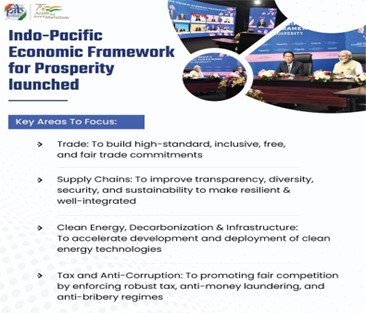
  • India’s participation in the U.S.-led Indo-Pacific Economic Framework further strengthens the India-U.S. partnership.

Dig Deeper: How many countries are members of the Indo-Pacific Economic Framework and read about the recently added country.

  • The results of the Lok Sabha elections were declared last week. The ruling National Democratic Alliance (NDA) won 293 seats with a 43.3% vote share, while the Opposition bloc INDIA, including the Trinamool Congress, secured 234 seats with a 41.6% vote share. Other regional parties and independents, polling around 15%, ended up with only 16 seats in total.
  • First Past the Post System (FPTP):
  • In the FPTP system, the candidate with the most votes in a constituency wins.
  • This system is used in India, the U.S., the U.K., and Canada.
  • Proportional Representation (PR):
  • Ensures representation based on vote share.
  • The ‘party list PR’ system allows voters to vote for parties, which then receive seats in proportion to their vote share, often with a minimum threshold of 3-5% for eligibility.
  • Mixed Member Proportional Representation (MMPR):
  • Combines FPTP and PR systems.
  • One candidate is elected through FPTP from each constituency, with additional seats filled based on parties’ vote percentages.
  • International Practices:
  • Presidential democracies like Brazil and Argentina use party list PR.
  • Parliamentary democracies like South Africa, the Netherlands, Belgium, and Spain also use PR.
  • Germany and New Zealand use MMPR, balancing FPTP and PR to ensure stability and proportional representation.
  • The Law Commission’s 170th report (1999) recommended experimenting with the MMPR system by filling 25% of seats through PR, ideally at the State/UT level.
  • Upcoming delimitation exercises post-2026 census could consider MMPR for incremental seats, addressing concerns of smaller states and preventing domination by larger states.

Dig Deeper: Read about the origin of the First Past the Post system and Proportional Representation in Modern democracies.

  • Epigraphs from the 16th to 19th centuries, on display at Kashmir Arts Emporium’s exhibition organised by the Islamic University of Science and Technology (IUST).
  • It provides insights into Kashmir’s history. These artefacts reveal the dominance of the Persian language, local Hindus’ praise for Sultan Sikander, and the construction of community wells by the Mughals.
  • The exhibition showcases rare devotional and literary works, including chronograms from over four centuries, starting with the Sultanate rule in the 14th century.
  • An inscription from Khanmoh mentions a ‘maath’ foundation during Zain-ul-Abidin’s reign, praising his father, Sultan Sikander.
  • Jamia Masjid Inscription highlights reconstruction efforts by native engineer Malik Haider and calligrapher Mulla Murad (Shirin Kalam), with engraving by Hindu craftsman Hari Ram.

Dig Deeper: Which Kashmir ruler had the title of ‘Butshikan’?

  • The greater adjutant stork is one of the most majestic bird species. Its habitat in India is the Brahmaputra valley of Assam.
  • The birds are found mostly in three districts of Assam — Guwahati, Morigaon, and Nagaon.  The wetlands in and around Guwahati were home to these storks, which depended on them for food, water and shelter.
  • The greater adjutant stork is shifted to near threatened from the earlier classification of endangered on the Red List of Threatened Species by the International Union for Conservation of Nature.
  • Almost five feet tall are recently seen at a garbage dumping site near the Deepor Beel Wildlife Sanctuary, a Ramsar site.
  • Between October and February period is the breeding season for the greater adjutant stork.
  • Principally carnivorous, the greater adjutant stork preys on fish, frogs, snakes and other reptiles, eels, birds, and, also, carrion.
  • Seasonally dependent on wetlands for foraging and tall trees for roosting and nesting, the storks suffer from the ongoing destruction of habitat through encroachment, overfishing and drainage projects.
  • Though the species has received legal protection in India, in many areas, people drive out these birds as they may carry pieces of rotting meat to feed their hatchlings and because their droppings carry a strong odour.

Dig Deeper: Read about the Hargila Army working for the conservation of Greater Adjutant Stork.

  • The Health Ministry and the Insurance Regulatory and Development Authority of India (IRDAI) are launching the National Health Claim Exchange (NHCX), a digital platform designed to provide patients with quick access to quality healthcare and reduce out-of-pocket expenses.
  • The NHCX will integrate insurance companies, healthcare service providers, and government insurance scheme administrators.
  • The NHCX will serve as a gateway for exchanging claims-related information among various stakeholders in the healthcare and health insurance ecosystem.
  • It aims to enable seamless interoperability of health claims processing, enhancing efficiency and transparency, and benefiting policyholders and patients.
  • The Insurance Industry supports this initiative, aiming for ‘Insurance for All by 2047’.
  • Twelve insurance companies and one TPA (Third Party Administrator) have completed NHCX integration.
  • The insurance authority has mandated that all cashless claims be processed within three hours of discharge authorization from the hospital.
  • The National Health Authority announced financial incentives under the Digital Health Incentive Scheme (DHIS) starting January 2023.
  • Hospitals will receive ₹500 per claim or 10% of the claim amount (whichever is lower) for every insurance claim transaction through NHCX.
  • The NHCX portal aims to streamline claims processing, reduce claim times, and standardize procedures, facilitating smoother operations within the healthcare space.

Dig Deeper: What is the difference between Insurance Penetration and Insurance Density? Read about the new guidelines of IRDAI released in 2024.