Search
Close this search box.

G7 in Italy, International Fatty Liver Day 2024, SBI Report on MPCE Trends

Table of Contents

Role of Human Activities in N2O emissions

  • N2O emissions from human activities have increased by 40% (3 MMT of N2O per year) in the past four decades.
  • Agricultural production using nitrogen fertilizers, such as ammonia, and animal manure contributed 74% of the total anthropogenic N2O emissions in the last decade.
  • N2O emissions from human activities, responsible for 6.4% of the effective radiative forcing of greenhouse gases, have added about 0.1 degree Celsius to current global warming.
  • India is the world’s second-largest source of nitrous oxide (N2O), a greenhouse gas that heats the atmosphere far more than carbon dioxide.
  • Nearly 11% of such global man-made emissions in 2020 were from India, topped only by China at 16%.
  • The major source of these emissions comes from fertilizer usage, according to a Global Assessment of N2O Emissions published in the journal Earth System Science Data.
  • In 2022, the concentration of atmospheric N2O reached about 25% above the levels seen before the industrial age. In comparison, the concentration of carbon dioxide was 417 parts per million in 2022.
  • This means that the current level of carbon dioxide in the atmosphere is a thousand times more than that of nitrous oxide, making carbon dioxide reduction the bigger priority among countries trying to contain climate change.
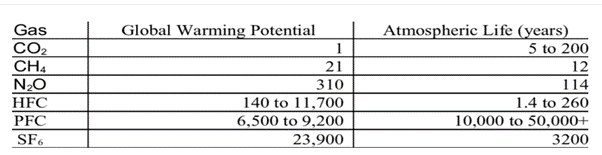
Dig Deeper: What is Global Warming Potential? Compare the role of agriculture-related activities in the emission of Methane and Nitrous oxide.
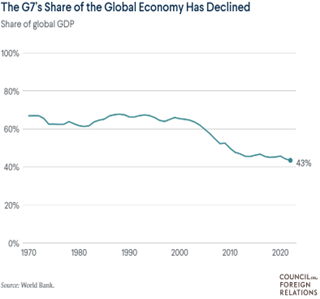
  • Prime Minister Narendra Modi will travel to the Apulia region of Italy to attend the G-7 outreach meet.
  • Apart from leaders of other G-7 countries — Canada, France, Germany, Japan, the U.K., and the U.S. —and the European Union leadership, India will be among leaders of 12 countries invited, including Algeria, Argentina, Brazil, Egypt, Kenya, Mauritania, Saudi Arabia, South Africa, Tunisia, Türkiye, and the UAE.
  • Last G7 meet of 2023 was hosted by Japan and G7 in 2025 will be hosted by Canada.
  • This is the 11th time India has been invited to the G-7 outreach and the current Prime minister will participate for the 5th time.
  • India will take part in a special session for discussions on artificial intelligence, energy, Africa and the Mediterranean.
  • Recently, Khalistani terrorists defaced a statue of Mahatma Gandhi, due to be inaugurated in the town of Brindisi not far from the G-7 venue.

Dig Deeper: What is D10 and which additional countries are part of it?

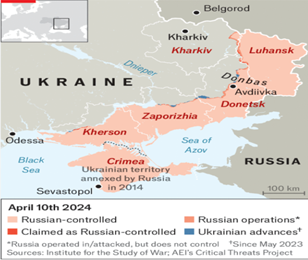
  • Switzerland has organised a Ukraine peace Summit in the capital Bern, which aims to chart a path toward possible peace nearly 28 months after Russian forces invaded Ukraine and the war grinding on.
  • Nearly 90 countries and organisations, half from Europe, have confirmed attending the Swiss-hosted Ukraine peace summit.
  • Moscow has not been invited but says it would not have attended anyway as the conference is based on the peace proposals of Ukrainian President Volodymyr Zelenskyy that Russia rejects.
  • India will be participating in the Peace Summit in Switzerland.
  • China and Brazil declined to participate in any Peace effort until and unless both sides are on the table.

Dig Deeper:  Which European countries maintain status as ‘Neutral Countries’ along with Switzerland?

  • The scientists of the Ahmedabad-based Physical Research Laboratory (PRL) have discovered three new craters on Mars.
  • They have been discovered in the Tharsis volcanic region on Mars.
  • On the recommendation of the PRL, the International Astronomical Union (IAU) Working Group for Planetary System Nomenclature approved naming the three craters on Mars.
  • One 65 km wide crater has been named ‘Lal Crater’ after Devendra Lal, a renowned Indian geophysicist and Director of the PRL.
  • The second 10-km wide crater has been named ‘Mursan crater’ after a town in Uttar Pradesh.
  • The third 10-km wide crater is the ‘Hilsa crater’ named after a town in Bihar.
  • The PRL stated that its entire area, in the Tharsis volcanic region on Mars, is covered with lava.
  • This crater has geophysical evidence of material other than lava, with a 45-metre-thick sedimentary deposit in its subsurface.
  • This discovery provides compelling evidence that water has moved large volumes of sediment into the Lal crater.
  • This finding also confirms that Mars was once wet, and water had flown on the surface.

Dig Deeper: What is the PLANEX programme?

  • A new study published in Nature Ecology & Evolution involving wild African savannah elephants also known as African Bush Elephants (Endangered) in Kenya supports the idea that elephants address each other by an equivalent of name.

Asian Elephants bury their calves

  • A recently published study in the ‘Journal of Threatened Taxa’ on elephants observed that Asian elephants bury their dead calves.
  • Earlier researchers observed African forest elephants covering deceased herd members with leaves and branches.
  • There is also evidence of mourning, moving dead bodies to specified sites and standing guard over dead bodies among Asian Elephants.
  • When an elephant makes a vocalisation to a group of other elephants, all of them respond.  
  • Yet, sometimes, when that same elephant makes a similar call to the group, only a single individual responds.
  • The researchers analysed vocalisations —mostly rumbles generated by elephants using their vocal cords, similar to how people speak — made by more than 100 elephants in Amboseli National Park and Samburu National Reserve.
  • Researchers used a machine-learning model to understand these patterns.
  • Elephants respond more strongly to calls addressed to them, showing enthusiasm and moving toward the sound.
  • Evidence of social bonds and maintaining multiple social relationships for elephants.
  • Elephants are the planet’s largest land animals and are highly intelligent.
  • They are known for keen memory, their problem-solving skills, and sophisticated communication.
  • Previous research has shown that they engage in complicated behaviour; visual, acoustic, and tactile gestures — when greeting each other.
  • It was also common for a mother to rumble to her calves, often to calm them down or check in with them.

Dig Deeper: Read about the MIKE Programme and IUCN classification of Asian Elephants and African forest elephants.

  • International Fatty Liver Day, observed annually in June, aims to raise awareness about liver health. This year’s theme, “Act Now, Screen Today,” underscores the urgency of early detection.
  • Non-Alcoholic Fatty Liver Disease (NAFLD)
  • Historically, liver diseases were primarily linked to excessive alcohol use. However, non-alcoholic fatty liver disease (NAFLD) is now a growing concern.
  • NAFLD has been reclassified as Metabolic dysfunction-associated steatotic liver disease (MASLD), highlighting its link to metabolic health, cardiac health, and cancer risk.
  • The prevalence of MASLD is alarming, with an estimated global rate of 25-30%.
  • A 2022 meta-analysis revealed a 38.6% prevalence of fatty liver among Indian adults and around 36% among obese children.
  • Excessive consumption of refined carbs and sugars worsens metabolic problems, leading to insulin resistance and fatty liver.
  • Insulin resistance disrupts normal metabolism, causing excess glucose to be converted into fatty acids and stored in the liver, resulting in fatty liver and potentially more severe conditions like steatohepatitis and cirrhosis.
  • Fatty liver disease often goes undetected in its early stages.
  • The liver is a silent organ that often shows no signs of damage until it’s advanced.

Dig Deeper: What are the reasons behind the epidemic of obesity in India despite a vegetarian diet?

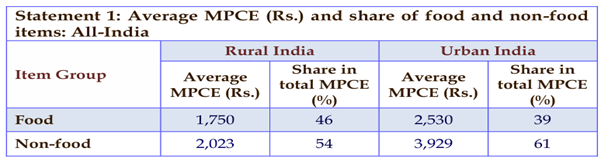
  • A State Bank of India research report, based on the NSSO’s 2022-23 Survey on Household Consumption Expenditure (HCES), reveals significant trends in Monthly Per Capita Consumption Expenditure (MPCE) across India.
  • Key Findings-
  • There has been a nearly equivalent increase in MPCE across all fractile classes in both rural and urban areas over the past decade.
  • The gap between the top and bottom fractiles in urban areas has sharply reduced.
  • Enhanced connectivity, particularly through the construction of rural roads under PMGSY and their convergence with National Highways, is improving rural consumption patterns.
  • Transformative measures like DBT transfers, PM Kisan, Ujjwala, MSP, eNAM, and AIF are bolstering rural infrastructure and contributing to a narrowing rural-urban MPCE gap.
  • About 30% of rural MPCE growth is driven by endogenous factors.
  • Persistent Disparities
  • The top 5% of the rural population has an average MPCE of ₹10,501, about 7.6 times higher than the bottom 5% (₹1,373).
  • In urban areas, this ratio is 10.4 times.
  • Southern and northern states have nearly twice the average MPCE compared to eastern states.
  • However, the eastern states show a slightly higher growth rate in rural areas, indicating potential for bridging the gap.
  • The Northeast states exhibit the highest percentage of decadal growth, benefiting from the ‘Look North-East’ policy, which has improved the ease of business and living.
  • There is a marked change in food habits across the country, with significant declines in rice consumption in the northeast and wheat consumption in the North and Central regions.

Dig Deeper: Read about various surveys conducted by NSSO and MoSPI.