Search
Close this search box.

Cyclonic Storm Remal, Kerem Shalom, Casual Labour Market

Table of Contents
  • The top UN court ordered Israel to halt military operations in Rafah immediately, a landmark ruling likely to increase mounting international pressure on Israel more than seven months into the Gaza war.
  • The International Court of Justice (ICJ) also ruled Israel must keep open the key Rafah crossing for unhindered humanitarian aid and urged the unconditional release of hostages taken by Hamas during its October 7 assault.
  • ICJ rulings are legally binding but the court has no concrete means to enforce them. For example, it ordered Russia to halt its invasion of Ukraine, to no avail.
International Court of Justice (ICJ)
The principal judicial organ of the United Nations (UN). The ICJ was established in 1945. All members of the UN are parties to the statute of the ICJ, and nonmembers may also become parties. The ICJ is a continuing and autonomous body that is permanently in session.The seat of the ICJ is at The Hague, but sessions may be held elsewhere. The official languages of the court are French and English.The court’s primary function is to pass judgment upon disputes between sovereign states. Only states may be parties in cases before the court, and no state can be sued before the World Court unless it consents to such an action.

South Africa brought the case before the ICJ last year alleging that Israel’s Gaza offensive breached the 1948 UN Genocide Convention — a charge strongly denied by Israel.

  • The ICJ ordered Israel to do everything it could to prevent acts of genocide during its military operation in Gaza.
  • The ICJ also ordered Israel to ensure unimpeded access to UN-mandated investigators to look into allegations of genocide.

Dig Deeper: Compare the mandate of ICJ and ICC.
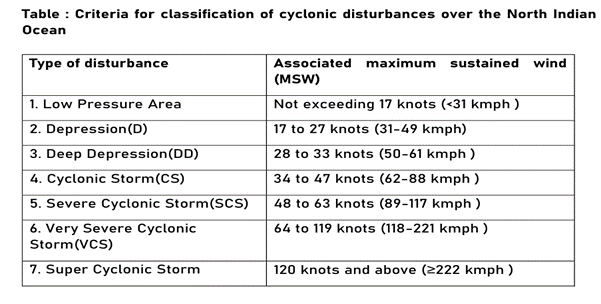
  • Cyclonic storm ‘Remal’, originating in the central Bay of Bengal, is expected to intensify into a severe cyclonic storm.
Council on Energy, Environment and Water (CEEW) study
Analysed the occurrence of tropical cyclones over five decades and found that the districts on the eastern coast of India are highly exposed to the impacts of cyclones. Initiatives like the National Cyclone Risk Mitigation Project (NCRMP) has been strengthening adaptive capacity of local stakeholders. It indicates that 100% of the population exposed to cyclones now has access to early warning systems.India needs to develop frameworks to climate-proof critical infrastructure. 

According to the latest input of the India Meteorological Department (IMD), the storm is likely to cross the coast between Sagar Island of West Bengal and Khepupara of Bangladesh with a wind speed of 110-120 kmph, gusting to 135 kmph.

  • According to the IMD, the well-marked low-pressure area over the Bay of Bengal concentrated into a depression.
  • It continued to move north-eastwards and intensified further into a cyclonic storm.
  • Subsequently, it would move nearly northwards and intensify into a severe cyclonic storm.
  • To ensure the safety of maritime traffic, the Coast Guard’s remote operating stations are broadcasting VHF (very high frequency) alerts.

Dig Deeper: Read about preconditions for the initiation of cyclones and various names of Tropical cyclones in different parts of the world.

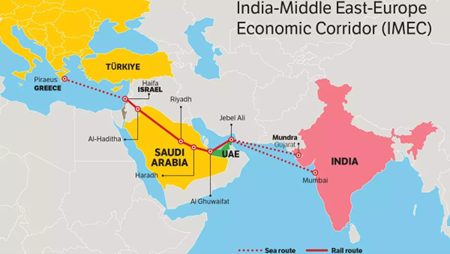
  • The IMEC, or the India-Middle East-Europe Corridor, was signed on the sidelines of the G-20 summit in New Delhi on September 2023 by the European Union, France, Germany, India, Italy, Saudi Arabia, the United Arab Emirates (UAE) and the United States.
  • Designed and formulated under the Partnership for Global Infrastructure and Investment (PGII).
  • The IMEC will comprise two separate corridorsan east corridor connecting India to the Arabian Gulf and a northern corridor connecting the Arabian Gulf to Europe.
  • It will include a railway network that aims to be a reliable and cost-effective cross-border ship-to-rail transit network for goods and services to transit.
  • It has plans to lay cable for electricity and digital connectivity and a pipeline for clean hydrogen export.
  • In its plan, the Indian ports of Kandla, Mumbai and Mundra will be connected by sea links to Fujairah, Jebel Ali and Abu Dhabi in the UAE in the east.
  • Followed by the rail-road link through Saudi Arabia and Jordan and onwards to Europe in the west by the port of Haifa in Israel, along with the ports in Marseille in France, Messina in Italy and Piraeus in Greece.
  • This 4,800 kilometre-long IMEC corridor aims to secure regional supply chains.
  • Currently, much of the trade between India and Europe is through the Suez Canal.
  • It is estimated that the time and cost of transporting goods to Europe from India will be reduced by 40%.
  • It is also being touted as an effective counter to China’s Belt and Road Initiative (BRI).

Dig Deeper: What are the Abraham Accords and their role in the success of IMEC?

  • India requires a structural shift towards structured and formal employment, said the Indian Staffing Federation (ISF)– the apex body representing the country’s contract-staffing industry.
  • Almost 85% of informal labour generates more than half of the GDP.
  • India has over 400 million informal labour market
  • It was imperative to initiate a structural shift towards formalisation to ensure equitable opportunities and sustainable livelihoods for all.
  • The apex body unveiled a blueprint for the formalisation of the informal workforce and implementation of labour codes in the country.
  • During the pandemic, where the formal workforce, comprising less than 15% with social security aided in overcoming the challenges.
  • Some of the recommendations made by ISF included-
  • Removing employment bottlenecks
  • Urgent implementation of the four labour codes in India
  • Policy changes and encouraging schemes
  • Consideration of employment services as ‘merit services’, with lower GST slab tax rates at 5% with ICT benefits instead of the current 18%
  • Linking of skilling initiatives to employment.

Dig Deeper: Read about Annual PLFS data and compare trends in the Labour Market of India.

Plurilateral Agreement:
A Plurilateral pact is binding on not only its signatories but also on non-members.India, South Africa, the U.S. and some others are non signatories to IFD Pact.India was concerned that it would put the onus on the government to consult investors on policy matters.South Africa also blocked the move.

India is under pressure at the WTO to give its consent for the inclusion of the proposed China-led Investment Facilitation for Development (IFD) pact in the formal WTO framework as a plurilateral agreement.

  • In the WTO’s General Council, the highest-level decision-making body in the WTO, New Delhi continued to oppose the move stating investment is not an issue for discussion at the WTO.
  • India has maintained its position on the issue, as outlined at the WTO 13th Ministerial Conference (MC13) in Abu Dhabi in February 2024.
  • At the WTO MC13, a joint ministerial declaration was issued by Trade Ministers from 123 WTO member countries, including the EU, finalising the IFD pact.

Dig Deeper: What is the Doha Development Agenda and new issues introduced in WTO negotiations?

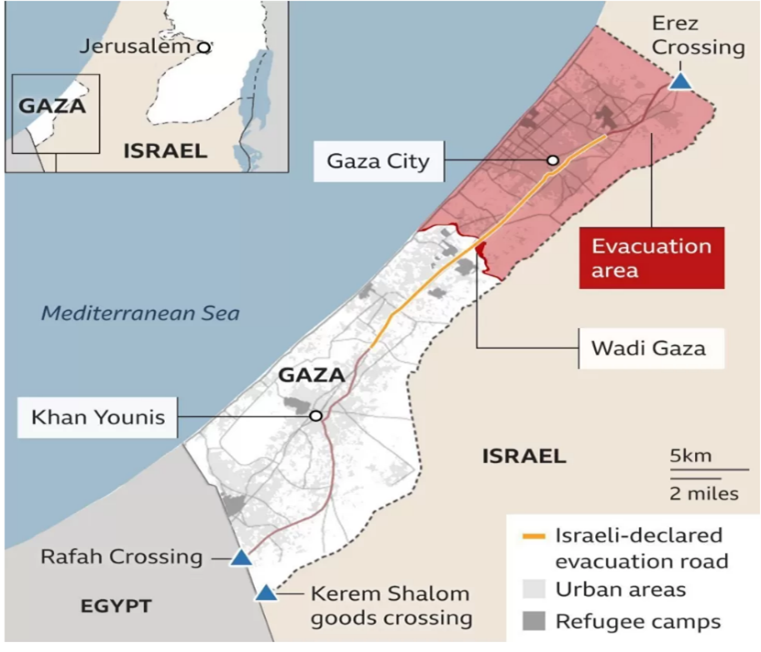
  • The U.S. welcomed Egypt’s commitment to allow UN-provided humanitarian aid to flow into Gaza temporarily through the Kerem Shalom crossing.
  • Rafah border crossing remains shut to aid deliveries for a third week and people inside the Palestinian enclave face worsening hunger.
  • Kerem Shalom translates into Vineyard of Peace is a kibbutz (utopian community) in southern Israel. It is located on the triple Gaza StripIsraelEgypt border.

Dig Deeper: Study map of Israel’s Neighbourhood, ports, border crossing and geographical features.

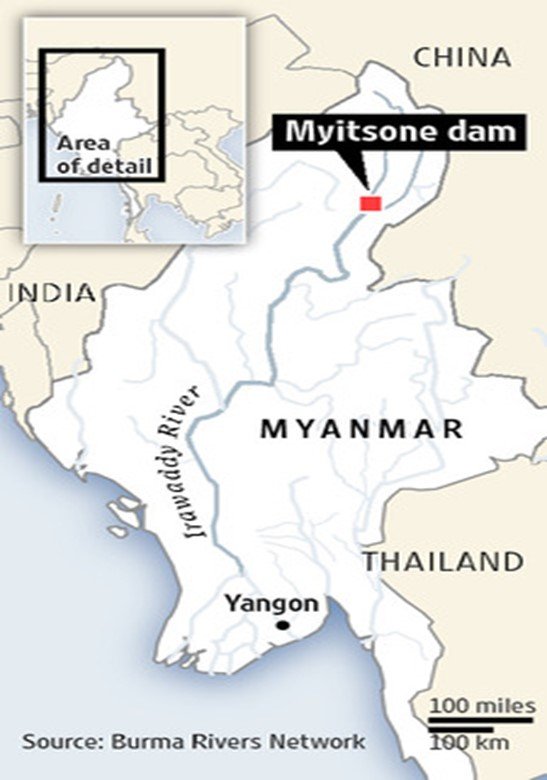
  • Myanmar revived plans for a $3.6 billion Chinese-backed 6,000-megawatt Myitsone dam in northern Kachin state on the Ayeyarwady River.
  • It would have exported around 90% of the power it generated to China and it would cause huge environmental damage.
  • A World Wide Fund for Nature (WWF) report in 2018 estimated that some 34 million people in Myanmar live in the Ayeyarwady basin, roughly two-thirds of the country’s population.
  • Northern Kachin state has been rocked by fighting between the Kachin Independence Army (KIA) and the military for decades.

Dig Deeper: Read about Hydropower projects of Arunachal Pradesh and the issues associated with it.