Search
Close this search box.

Axiom-4 Mission, Balance of Payments (BoP), Doctrine of Essentiality

Table of Contents

(General Studies II – Polity Section – Indian Constitution—Historical Underpinnings, Evolution, Features, Amendments, Significant Provisions and Basic Structure.

– Structure, Organization and Functioning of the Executive and the Judiciary—Ministries and Departments of the Government; Pressure Groups and Formal/Informal Associations and their Role in the Polity.)

  • Religion often involves cultural beliefs, worldviews, texts, prophecies and morals that have spiritual meaning to members of the particular faith.
  • Religious Practices are a range of practices including sermons, rituals, prayer, meditation, holy places, symbols.
  • Whereas Spiritual Orientations can be defined as a search for truth that involves a process of transformation.
  • At times religious Practices are loggerheads with judicial definitions of essential practice doctrine under fundamental rights in multicultural societies.

What are Essential Practices?

  • The doctrine of “essentiality” was invented by a seven-judge Bench of the Supreme Court in the ‘Shirur Mutt’ case in 1954. The court held that the term “religion” will cover all rituals and practices “integral” to a religion, and took upon itself the responsibility of determining the essential and non-essential practices of a religion.
  • The doctrine of essential religious practice determines which religious practices would be protected under Articles 25 and 26 of the Constitution.
  • Dr. B.R Ambedkar’s speech in the Constituent Assembly stated that The State should be allowed to intervene in matters that touch upon religion or are connected with it but are not intrinsically religious, to differentiate between what was secular from what was religious.
  • It is essential to differentiate the practices which help us to transform spitually and the superstitious practices.

Evolution of Essential Practices Doctrine

  • Shri Shirur Mutt Case, 1954: Supreme Court held that the term “religion” will cover all rituals and practices “integral” to a religion. Article 25(2)(a) allows regulation of the economic, political, or commercial activities which are associated with religious practices.
  • Mohd. Hanif Quarashi & Others vs The State Of Bihar, 1958 The apex court held that the sacrifice of a cow on the occasion of Eid was not an essential religious practice for Muslims.
  • Dr. M. Ismail Faruqui Etc, Mohd. V Union of India And Others, 1994 The court decided on the question of whether praying at the mosque is an essential Islamic practice and held that while offering prayers is an essential practice, the offering of such prayers at the mosque is not and namaz (prayer) by Muslims can be offered anywhere.

Shayara Bano v Union of India, 2017 (Triple Talaq case) The Supreme Court rejected the argument that Triple Talaq was an essential practice under Quran.

Issues with Essential Practices Doctrine

  • Courts have assumed grave power to decide whether a practice that was religious in nature was also “essential” to that religion. The Courts become “ecclesiastical authorities” which was never intended.
  • Courts infringe on the autonomy of religious groups to decide what they consider inviolate. This leads to the erosion of Freedom of religion.
  • It also prevents social reforms which happen organically in society as once a court holds a practice as essential to the religion, no law can be passed to change it.
  • Justice Indu Malhotra, in the dissenting opinion in the Sabarimala case, added that “What constitutes essential religious practice is for the religious community to decide, not for the court” and “Present judgment won’t be limited to Sabarimala, it will have wide ramifications. Issues of deep religious sentiments shouldn’t be ordinarily interfered into.”

There is no clarity in the Constitution regarding what forms part of essential religious practices and the Courts have become the sole authority to decide on this question. Lack of certainty leads to chaos many times. The Judges should not become clergy to decide upon religious doctrines. If the essential practices that are in dissonance with constitutional ethos and values should not be allowed. It is not religious morality but constitutional morality should govern us.
International Space Station (ISS)

  • Launch Date: November 20, 1998
  • Function: Serves as a habitat for astronauts in space.
  • Continuous Inhabitation: Since 2011
  • Participating Agencies: NASA (United States), Roscosmos (Russia), ESA (Europe), JAXA (Japan), CSA (Canada)
  • Orbit: Approximately 400 kilometers above Earth
  • Speed: About 28,000 kilometers per hour, orbiting Earth approximately every 90 minutes
  • Objectives: Expand knowledge about space and microgravity, promote new scientific research, and exemplify international cooperation.
  • The Indian Space Research Organisation (ISRO) has shortlisted two astronauts for a mission to the International Space Station (ISS) in collaboration with NASA.
  • Only one of these astronauts will embark on the mission, scheduled to take place “no earlier than October 2024.
  • The selected astronaut will undergo additional training in the United States to familiarize with ISS modules and protocols.
  • This mission, known as Axiom-4, is part of NASA and Axiom Space’s fourth private astronaut mission.
  • The mission highlights ongoing collaboration between India and the United States in space exploration.
  • India’s own human spaceflight mission, Gaganyaan, is expected to be launched no earlier than 2025.
  • This mission marks a significant milestone in India’s space exploration efforts and its international collaboration in space technology.

Dig Deeper: What isArtemis Mission and Artemis Accords?

  • The Speaker of the West Bengal Legislative Assembly administered the oath to two newly-elected Trinamool Congress MLAs, despite the Governor’s directive assigning the Deputy Speaker for the task, resulting in a controversy.
  • Article 188 of the Constitution of India empowers the Governor of a state to appoint a person before whom a member of the Legislative Assembly (MLA) or Legislative Council (MLC) must take an oath or affirmation before assuming their duties.

Pro-tem Speaker

  • A Pro-tem speaker temporarily presides over the first meeting of a newly constituted Lok Sabha or State Legislative Assembly.
  • Selection: By convention, the senior most member (by membership, not age) is chosen.
  • Duties: Administers the oath of office to new members.
  • Enables the House to elect a new speaker.
  • Manages House tasks if both the speaker and deputy speaker posts are vacant.
  • Administers the floor test.
  • Similar Provision for Lok Sabha MPs under Article 99 stipulates that every member of Parliament (MP) must make and subscribe to an oath or affirmation before taking their seat in the Lok Sabha (House of the People) or the Rajya Sabha (Council of States).
  • The President of India appoints a person to administer this oath, typically the Protem Speaker or another designated official.
  • Recently Lok Sabha Speaker has amended the oath-taking rules for Members of Parliament, prohibiting additional remarks after instances of members resorting to slogans during the 18th Lok Sabha oaths.

Dig Deeper: Which is the schedule which consists of oath and affirmations?

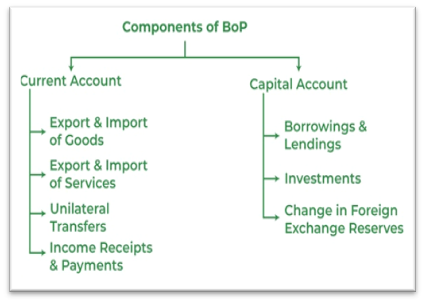
  • It is a comprehensive record of a country’s economic transactions with the rest of the world.
  • It tracks the inflow and outflow of money, showing how much money enters (positive) and exits (negative) the country. A deficit is indicated by a negative sign.
  • It BoP reflects the demand for the domestic currency (rupee) against foreign currencies (like the dollar).
  • A current account deficit or surplus isn’t inherently good or bad its Context matters:
  • Current Account Deficit: Often seen in developing economies like India, which need to import capital goods to build production capacity. Indicates strong demand in the economy.
  • Current Account Surplus: Might indicate economic slowdown, as seen during FY2020-21 due to Covid-19 lockdowns.
  • Optimal Deficit: A current account deficit of 1.5%-2% of GDP is generally consistent with a GDP growth rate of 7%-8%.

Dig Deeper: What are different types of deficits (Primary, Fiscal, Revenue Etc.) ?

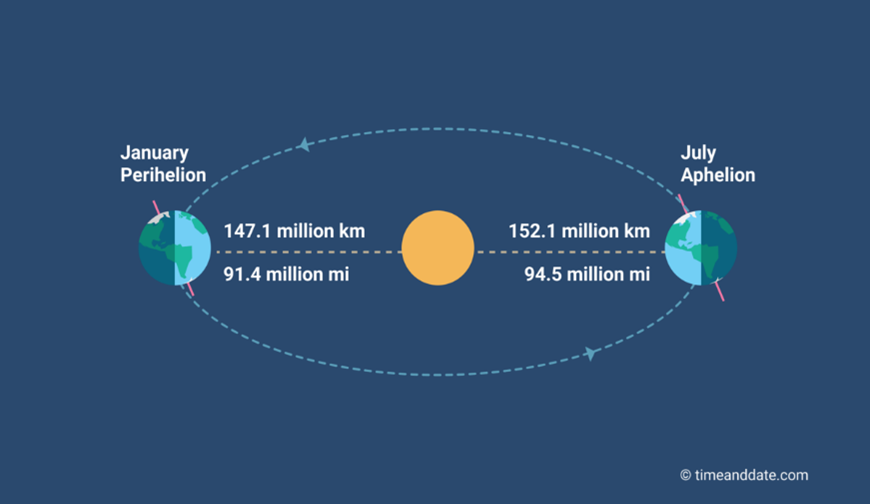
  • Aphelion, the farthest point in Earth’s elliptical orbit around the sun, occurs annually in July.
  • This year, it happened on July 5 at 1:06 a.m. Eastern time.
  • Earth’s orbit, though primarily circular with an eccentricity of 0.017, varies slightly in distance, with Earth being about 94.5 million miles away from the sun at aphelion and approximately 91.5 million miles closer at perihelion in January.
  • The concept of aphelion is significant because it marks a moment when Earth receives 7% less sunlight compared to perihelion.
  • During aphelion, despite the reduced sunlight, the Northern Hemisphere experiences longer and hotter summer days due to its tilt towards the sun.
  • Over long periods, Earth’s orbit is influenced by gravitational interactions with other planets, particularly Jupiter, which are gradually reducing its eccentricity, potentially leading to a more circular orbit in the future.

Dig Deeper: What do you understand by Eccentricity and Milankovitch Cycles?

  • A People’s Biodiversity Register (PBR) is a comprehensive document that records the biodiversity of a specific area, including details about local ecosystems, landscapes, species, and traditional knowledge.
  • Kerala was the first state in India to publish PBRs for all its local bodies, setting an example for other states to follow.
  • It’s created with the active participation of local communities and mandated under The Biological Diversity Act, 2002.
  • The Biological Diversity Act, 2002, enacted by the Government of India, aims to conserve biological resources and ensure equitable benefit-sharing.
  • It establishes mechanisms like People’s Biodiversity Registers (PBRs), documenting local biodiversity and traditional knowledge.
  • The National Biodiversity Authority (NBA) regulates resource access nationwide.
  • Biodiversity Management Committees (BMCs) oversee PBRs locally, while State Biodiversity Boards (SBBs) coordinate state-level conservation efforts and strategies.

Dig Deeper: Read about Nagoya and Cartagena Protocols.

  • The doctrine originated in the Shirur Mutt case (1954) and has been refined through subsequent Supreme Court judgments.
  • It is used to interpret and apply Articles 25 and 26 of the Indian Constitution, which guarantee freedom of religion.
  • The doctrine holds that only practices essential or integral to a religion are protected under constitutional religious freedom.
  • Courts, rather than religious authorities, have the power to determine what constitutes an essential religious practice.
  • Courts consider factors such as the practice’s antiquity, consistency, importance to the religion, and the consequences of its omission.
  • Judges examine religious texts, doctrines, and historical practices to assess a practice’s essentiality.
  • The doctrine aims to balance religious freedom with social reform and other constitutional principles.
  • There has been a shift from a more subjective approach (based on community beliefs) to a more objective judicial assessment.
  • The doctrine has been applied in significant cases like the Sabarimala temple entry, triple talaq, and hijab ban controversies.
  • The doctrine faces criticism for potentially allowing judicial overreach into religious matters and for the challenges in applying a uniform test across diverse religious traditions

Dig Deeper: Read about various doctrines which are in news from time to time such as Doctrine of Pith and Substance, Doctrine of Eclipse etc.