
- The IMEC, or the India-Middle East-Europe Corridor, was signed on the sidelines of the G-20 summit in New Delhi on September 2023 by the European Union, France, Germany, India, Italy, Saudi Arabia, the United Arab Emirates (UAE) and the United States.
- Designed and formulated under the Partnership for Global Infrastructure and Investment (PGII).
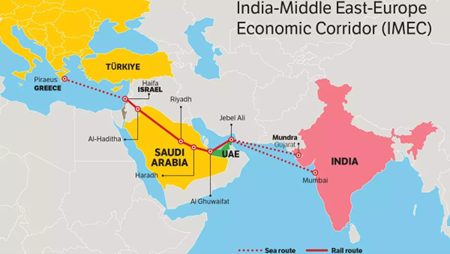
- The IMEC will comprise two separate corridors — an east corridor connecting India to the Arabian Gulf and a northern corridor connecting the Arabian Gulf to Europe.
- It will include a railway network that aims to be a reliable and cost-effective cross-border ship-to-rail transit network for goods and services to transit.
- It has plans to lay cable for electricity and digital connectivity and a pipeline for clean hydrogen export.
- In its plan, the Indian ports of Kandla, Mumbai and Mundra will be connected by sea links to Fujairah, Jebel Ali and Abu Dhabi in the UAE in the east.
- Followed by the rail-road link through Saudi Arabia and Jordan and onwards to Europe in the west by the port of Haifa in Israel, along with the ports in Marseille in France, Messina in Italy and Piraeus in Greece.
- This 4,800 kilometre-long IMEC corridor aims to secure regional supply chains.
- Currently, much of the trade between India and Europe is through the Suez Canal.
- It is estimated that the time and cost of transporting goods to Europe from India will be reduced by 40%.
- It is also being touted as an effective counter to China’s Belt and Road Initiative (BRI).
Dig Deeper: What are the Abraham Accords and their role in the success of IMEC?
