
- Researchers at the Government College for Women, Thiruvananthapuram, have developed a method to produce activated carbon from coconut husks, a major agricultural residue in Kerala.
- This biowaste-derived activated carbon promises sustainable and efficient solutions for high-performance supercapacitors due to its availability, low cost, and eco-friendly nature.
- Supercapacitors, which offer significantly higher capacitance and energy storage capacity than conventional capacitors, are crucial for sustainable energy storage.
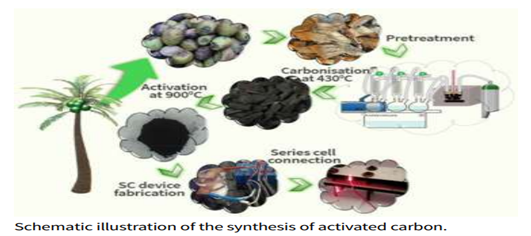
- Finding an ideal electrode material for supercapacitors has been challenging, but the research team discovered that prototype supercapacitors made from coconut husk-derived activated carbon are four times more efficient than existing ones.
Activated carbon
- It is produced from high-carbon materials like lignocellulosic and coal, is used primarily for water purification.
- A material with a large surface area, microporosity, and complex surface chemistry, making it effective at adsorbing heavy metals.
- There are two types: H-type (positively charged and hydrophobic) and L-type (negatively charged and hydrophilic).
- Activated carbon comes in four forms: powdered (PAC), granular (GAC), fibrous (ACF), and cloth (ACC), with commercial activated carbon (CAC) widely used globally.
- The team utilized an innovative microwave-assisted method designed at the college’s Centralised Common Instrumentation Facility (CCIF).
- Their findings have been published in the American Sustainable Resource Management Journal.
Dig Deeper: Read about the difference between Capacitors and Supercapacitors.
