
- Myanmar’s junta has ordered thousands of people living outside the Rakhine state capital Sittwe, to vacate their homes and head into the city.
- Sittwe city is one of the few holdouts for junta troops in western Rakhine state, where the Arakan Army (AA) has taken over large territory.
- The AA is said to be fighting for autonomy for the state’s ethnic Rakhine population and has vowed to capture Sittwe, home to an India-backed deep-sea port and around 2,00,000 people.
- After Chabahar, India has gained the right to operate a second overseas port, Sittwe, in Myanmar.
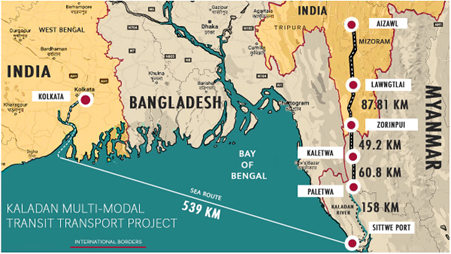
- The Ministry of External Affairs (MEA) has approved a proposal for India Ports Global (IPGL) to take over the operations of the entire port located on the Kaladan River.
- IPGL is a company 100 per cent owned by the Ministry of Ports, Shipping and Waterways.
- The Sittwe Port, situated in Myanmar’s Rakhine State, is a vital element of the Kaladan multi-modal transit transport project.
- This deep-water port enhances connectivity by facilitating cargo movement from Vizag and Kolkata to the Northeastern states of India, bypassing Bangladesh.
- Additionally, it alleviates reliance on the Siliguri Corridor, a narrow passage between Bhutan and Bangladesh.
- In the Indian Ocean, China and India are engaged in a struggle to expand their economic influence. Ports have become highly significant in this rivalry.
- India’s operational control over Sittwe and Chabahar ports bolsters its maritime influence, serving as a strategic counter to China’s String of Pearls strategy, which includes ports like Hambantota in Sri Lanka and Djibouti in Africa.
Dig Deeper: Locate India’s similar initiatives in Oman, Singapore and Indonesia on the map.
