
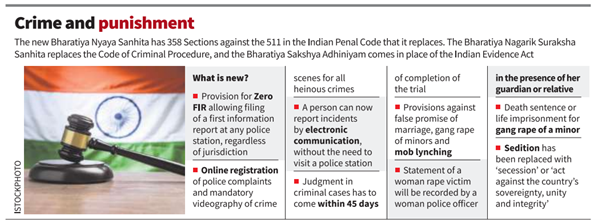
- As three new criminal laws come into effect across the country today.
- States can bring their own amendments to certain provisions of the Bharatiya Nagrik Suraksha Sanhita (BNSS), which replaces the Code of Criminal Procedure (CrPC).
- The BNSS outlines procedures and conditions for arrest, bail, and custody.
- The Bharatiya Nyaya Sanhita (BNS), replacing the Indian Penal Code of 1860, may soon be amended to include sections on sexual crimes against men and transgender persons, till that amendments police officers should use related sections in the BNS, such as wrongful confinement and physical hurt, for such complaints.
- The third law, Bharatiya Sakshya (BS), replaces the Indian Evidence Act, of 1872.
Concerns
- New power to handcuff without court permission
- Reintroduction of solitary confinement.
- FIR can be registered anywhere in the country, potentially leading to jurisdictional abuses and violations of fundamental rights.
- Cognizable offenses will be registered under Section 173 of the BNSS, instead of Section 154 of the CrPC.
- However, the IPC and CrPC will still run concurrently with the new laws for pending cases and crimes reported later that occurred before July 1.
- Training and support have been provided to all states to help them adapt to the new system.
- FIRs are filed through the Crime and Criminal Tracking Network Systems (CCTNS), which also includes unusual recordings during search and seizure processes.
- The Home Ministry is testing eSakshya, a mobile-based application to help police record crime scenes, search, and seizure, and upload files to a cloud-based platform.
- Some states have developed their own systems based on their capacities.
- For instance, the Delhi Police have developed the e-Pramaan application, which aids investigating officials in recording crime scenes and generating a hash value with a certificate under Section 62 of Bharatiya Sakshya.
Dig Deeper: Go through State List subjects under Schedule 7 of the Indian Constitution.
