Search
Close this search box.

Daily Current Affairs Prelims 06 May 2024

Table of Contents
  • History and Cause of Dispute– A lease agreement was signed between the Maharaja of Travancore and the Secretary of State for India for Periyar irrigation works in 1886. – Apart from 8000 acres of land, 155ft above the Periyar water level, was given on lease of 999 years to the then Madras government.- It allowed the complete diversion of water from about 648 sq. km of the Periyar basin above the dam.- Since 1979, the structural stability of the dam has been questioned and multiple litigations in the court by Kerala to decommission the dam- Whereas Tamil Nadu wants to increase the height of the water level for power and irrigation dependency. Tamil Nadu has accused Kerala in the Supreme Court of wilfully obstructing work essential to maintaining the 125-year-old Mullaperiyar dam.
  • Tamil Nadu argued the reconstituted supervisory committee even with powers under the Dam Safety Act, 2021, had miserably failed to facilitate strengthening works.
  • The dam is located after the confluence of the Mullaiyar and Periyar rivers, the west-flowing perennial river originates from the Sivagiri group of hills in the Western Ghats.
  • The dam has a height of 53.66 metres and 365.85 metres in length. The dam is owned, operated and maintained by Tamil Nadu.
  • The Mullaperiyar Dam is a gravity dam made with concrete prepared from limestone and burnt brick powder and faced with rubble.
  • The Periyar National Park in Thekkady is located around the dam’s reservoir and the lake created by the dam is also known as Periyar Thekkady Lake.

Dig Deeper: Learn about

Western Ghats, Gadgil committee and Kasturirangan committee
  • Percussion maestro Aravindakshan Marar passes away whose name was synonymous with Thrissur Pooram Festival of Kerala.
  • Since 1796, the temple festival has been observed yearly with a lot of grandeur in the month of Medam.
  • Observed at the Vadakkunnathan Temple in Thrissur, people from all over the world visit the temple to offer their prayers to Lord Vadakkunnathan.
  • An elaborate procession of 50 decorated elephants with the traditional music of Chenda Melam and Pancha Vadyam marks the festival’s main attraction.
  • It is one of the most popular temple festivals celebrated all over the world.

Dig Deeper: Read about Vishu, Theyyam festival and Onam

  • Catatumbo lightning is a natural phenomenon in which lightning strikes almost continuously, happens at the Catatumbo River of Venezuela where it meets Lake Maracaibo largest lake in the country.
  • Warm, moist air from the Caribbean Sea is pushed towards the Andes mountains, where it collides with cooler air descending from the peaks.
  • As the warmer air is forced to rise rapidly by the shape of the local landscape, it cools and condenses, forming towering cumulonimbus clouds.
  • Meanwhile, the combination of strong winds and temperature differential generates electrical charges within these clouds.
  • The cumulonimbus clouds load up on static electricity. When the electrical potential within the clouds becomes too great, it discharges in the form of lightning.
  • The strikes occur for up to 160 nights in a year, with an average of 28 lightning strikes per minute at its peak.
  • Thanks to this constant flow of current, the area has earned the title of ‘the lightning capital of the world’.

Dig Deeper: Read about Ball Lightning and Spider lightning

  • Recently scientists claimed a drought across southern Africa has been driven mostly by the El Nino weather pattern, not climate change.
  • Zambia, Zimbabwe and Malawi have declared a national disaster over the severe dry spell that started in January and has devastated the agricultural sector, decimating crops and pastures.
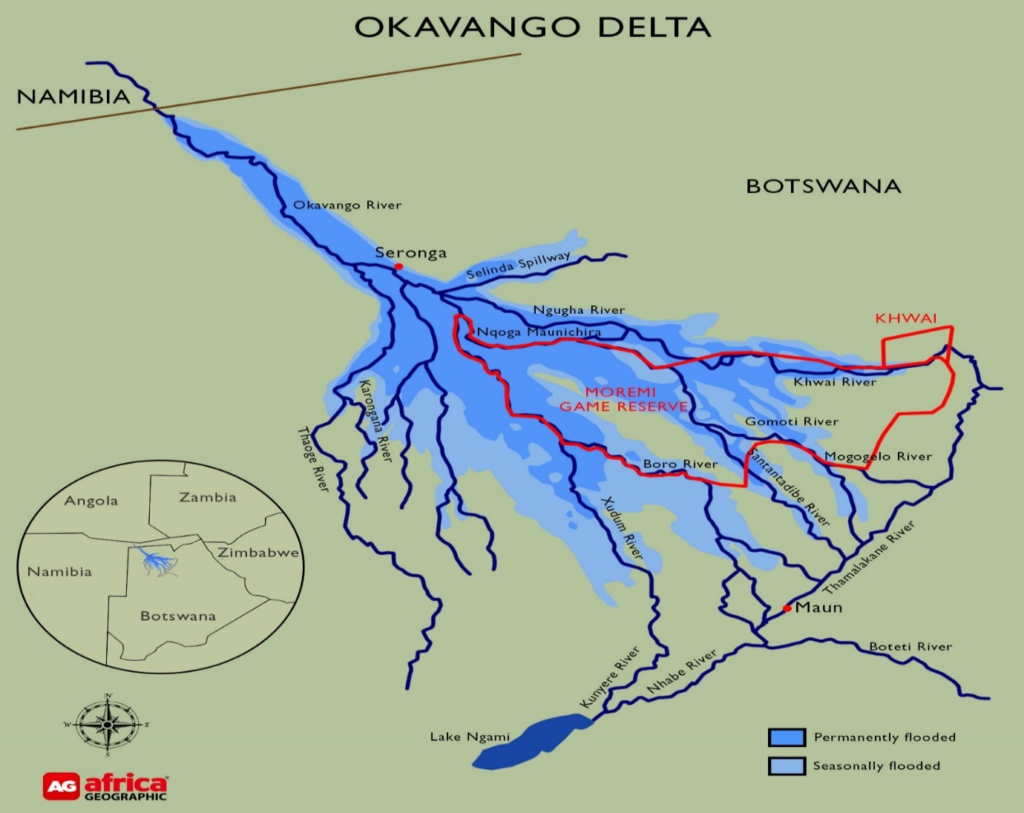
  • Okavango Delta located in north-west Botswana is a UNESCO World Heritage site that has faced severe drying this year.
  • It is one of the very few major interior delta systems that do not flow into a sea or ocean, with an almost intact wetland system.
  • One of the unique characteristics of the site is that the annual flooding from the river Okavango occurs during the dry season, with the result that the native plants and animals have synchronized their biological cycles with these seasonal rains and floods.
  • The Okavango Delta is home to some of the world’s most endangered species of large mammals, such as the cheetah, hippopotamus, white rhinoceros, black rhinoceros, African wild dog and lion.

Dig Deeper: Learn about East African geography

  • The Indian National Centre for Ocean Information Services (INCOIS), which had forecast the sea swell surges across the East and West coast, continued to caution coastal States to remain alert to the sea being rough with high waves and inundation of low-lying areas.
  • Water gushed into the low-lying areas and surging of water is still being experienced. Significant damage has been reported in coastal establishments during these wave surges in Kerala and Tamil Nadu.
  • The wave surges and rough sea conditions associated with high-period swell waves are approaching from the distant southern Indian Ocean.
  • Swell waves are surface gravity waves on the ocean which are not produced by the local wind and come in at a longer wavelength than waves produced by the local wind.

Dig Deeper: Read about Tides and impact of moon on Earth

  • Researchers at Sweden’s Linköping University have successfully created a free-standing sheet of gold, just one atom thick, termed “Goldene.”
  •  This marks the first time a metal has been formulated into freestanding 2D sheets, presenting novel opportunities for future applications.
  • While graphene, an atom-thin material made of carbon, has been known since 2004, producing atom-thin metallic sheets proved challenging due to metals’ propensity to form nanoparticles.
  • Goldene, approximately 100 nanometres thick, holds immense potential for various applications, particularly in the electronics industry.
  • Its economic viability and high conductivity make it an attractive catalyst.
  • Additionally, the technique used to create goldene can be applied to other metallic objects, with ongoing research focusing on iridium and platinum.
  • Goldene’s unique properties, stemming from its 2D structure, open avenues for diverse applications such as carbon dioxide conversion, hydrogen-generating catalysis, selective production of chemicals, and water purification.
  • This breakthrough underscores the continuous exploration of materials at the atomic scale, paving the way for innovative advancements in science and technology.

Dig Deeper: Learn about Nanomaterial and Graphene