Search
Close this search box.

Daily Current Affairs Prelims 04 May 2024

Table of Contents
  • India’s score in the World Press Freedom Index fell from 36.62 in 2023 to 31.28 in 2024, according to Reporters Without Borders (RSF for Reporters sans Frontières).
  • India’s rank improved from 161 in 2023 to 159 in 2024 as other countries slipped in ranking.
  • Norway and Denmark topped the RSF table while Eritrea was at the bottom, with Syria just ahead of it. Press freedoms fell by an average of 7.6 points globally.
  • It covers five categories — political context, legal framework, economic context, sociocultural context and security. Scores for India worsened in all but the security indicator.

Dig Deeper: Read about Press Council of India
  • Poor identification and certification of brain stem death or brain death cases is keeping the rate of organ donations at low levels in India according to the Health Ministry.
  • The rate of organ donations remains at less than one donor per million population in a year.
  • The Directorate General of Health Services (DGHS) asked health authorities:
  • To identify each potential brain death case
  • Inquire whether the potential donor has pledged for organ donation.
  • If not, hospital authorities should make family members aware of the opportunity to donate organs before the heart stops.
  • The doctor on duty in hospitals, with the help of the transplant coordinator, should make necessary inquiries after the brain death cases are certified by the competent authority.
  • The DGHS issues the Standard Operating Procedure under the provisions of the Transplantation of Human Organs and Tissues Act, 1994.
  • The Health Ministry asked hospitals to install ‘Required Request Display Boards’ at strategic locations conveying the message to save lives.
  • Going by the transplant data, a total of 16,041 organs, mostly kidneys, were donated in 2022. Delhi topped the country with 3,818 donations.

Dig Deeper: Learn about National Organ & Tissue Transplant Organisation

  • All spices, including ready-to-eat food, heading to Singapore and Hong Kong must be tested for Ethylene Oxide (ETO) presence and cleared by the Spices Board.
  • The Spices Board is the regulatory body under the Commerce Department.
 Spice Board Spices Board was constituted under the Spices Board Act 1986 with the merger of the Cardamom Board (1968) and Spices Export Promotion Council (1960). Spices Board is one of the five Commodity Boards functioning under the Ministry of Commerce & Industry. It is an autonomous body responsible for the export promotion of the 52 scheduled spices and development of Cardamom (Small & Large).


Main FunctionsResponsibilities for Export PromotionMulti-faceted ActivitiesPackage of service for Exporter/Importers
Research, Development and Regulation of domestic marketing of Small & Large Cardamom  Quality certification and control  Development and implementation of better production methods, through scientific, technological and economic research.  Helps exporters and importers establish mutual contact.
Post-harvest improvement of all spices  Registration of exporters  Guidance to farmers on getting higher and better-quality yields through scientific agricultural practices.  Identifies competent supply sources for specific requirements of importers  
Promotion of organic production, processing and certification of spices  Collection & documentation of trade information  Provision of financial and material support to growers.  Processes and forwards foreign trade enquiries to reliable exporters.  
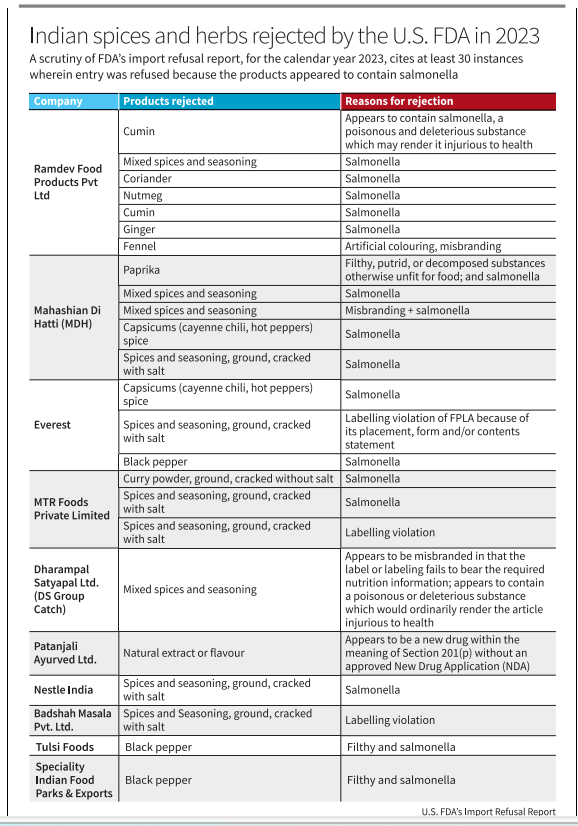
  • Hong Kong recalled three spice blends made by India’s MDH and a spice mix for fish curry made by Everest.
  • Singapore ordered a recall of the same Everest mix, stating it contained high levels of ETO, a prohibited pesticide. It is a colourless, flammable gas that was originally intended for sterilising medical devices. It could cause cancer in humans.
  • The U.S. and Australia also raised concerns about the quality of some Indian spices. India exported spices worth $3.95 billion in FY23, per the Spices Board.

Dig Deeper: Read about Food Adulteration and various methods to tackle it

  • A primary dealer (PD) is an RBI-registered entity authorized in buying and selling government securities (G-Secs). There are two types of primary dealers in India. Standalone primary dealers and bank primary dealers.
  • The standalone primary dealers are either subsidiaries of scheduled commercial banks Indian subsidiaries of entities incorporated abroad or companies incorporated under Companies Act 1956 and are registered as Non-Banking Financial Companies (NBFC).
  • To expand sources of funding for standalone primary dealers (SPDs), the Reserve Bank of India (RBI) allowed them to borrow in foreign currency from their parent or correspondent outside India or any other central bank-permitted entity and avail overdraft in nostro accounts (not adjusted within five days), only for operational reasons.
  • This comes in the backdrop of JP Morgan announcing India’s inclusion in Global Emerging Market Bond Index.

Dig Deeper: Learn about powers of RBI and SEBI

  • China launched a lunar probe to land on the far side of the moon and return with samples that could provide insights into the less-explored region.
  • The rocket carrying the Chang’e-6 lunar probe lifted off from the Wenchang launch centre on the island province of Hainan.
  • China also has a three-member crew on its own orbiting space station and aims to put astronauts on the moon by 2030.
  • Free from exposure to Earth and other interference, the moon’s mysterious far side is ideal for radio astronomy and other scientific work.
  • As the far side never faces Earth, a relay satellite is needed to maintain communications.

Dig Deeper: Read about Far side of the moon and reason why we see only one side of the moon.

  • Delhi High Court flagged rampant use of Oxytocin hormone in the dairy colonies of Delhi
  • It directed the Department of Drugs Control, GNCTD, to take action under section 18(a) of the Drugs and Cosmetics Act, 1940.
  • Only one public sector undertaking, the Karnataka Antibiotics and Pharmaceuticals Limited (KAPL) is permitted to produce Oxytocin to meet the needs of the entire country.
  • Oxytocin is also known as the ‘love hormone’.
  • It is secreted by the pituitary glands of mammals during sex, childbirth, lactation or social bonding.
  • It is chemically manufactured and administered either as an injection or a nasal solution to use in childbirth.
  • Oxytocin is administered to cattle to “force milk let-down and increase the production of milk”.
  • Administering of Oxytocin amounts to animal cruelty, and is a cognisable offence under Section 12 of the Prevention of Cruelty to Animals Act, 1960.

Dig Deeper: Learn about various important hormones like testosterone and oestrogen

  • The practice of cutting product portions while keeping the price the same is called as the ‘Shrinkflation’.
  • South Korea has decided to call it an unfair practice subject to penalties.
  • Most processed food makers and manufacturers of household supplies will have to display labels for three months if they downsize their products in a way that prompts the unit price to go up.
  • It prevents a situation where companies reduce the size, standard, weight or quantity of their products without sufficient notice.

Dig Deeper: Read about creeping, galloping and hyper inflation