
- Electric vehicles, supported by state-led incentives and subsidies, exemplify sustainability, with regenerative braking being a key mechanism that increases energy efficiency.
- In electric vehicles, a battery powers an electric motor (traction motor), which propels the vehicle.
- Understanding Braking
- Braking slows down a moving vehicle by removing kinetic energy, which must be transferred elsewhere due to the law of energy conservation. For example, disc brakes convert kinetic energy into heat through friction.
- Regenerative braking converts the kinetic energy of a vehicle’s wheels into a storable form for future use.
- Downsides of Regenerative Braking
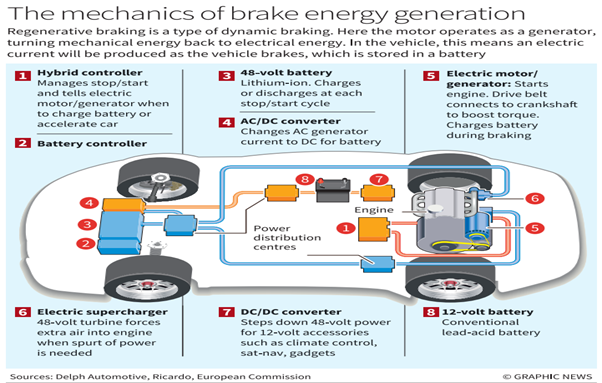
- Regenerative braking alone often can’t stop a vehicle completely and must be used with conventional brakes to dissipate kinetic energy as heat.
- It also can’t prevent vehicles from backsliding downhill and recovers less energy as the vehicle slows down.
- Despite these downsides, regenerative braking is beneficial for energy efficiency in stop-start traffic.
Dig Deeper: Read about Induction braking systems.
