Search
Close this search box.

Women Workforce: Distribution, Causes and solutions, World’s Oldest Cave Painting, Regenerative Braking

Table of Contents

(General Studies III – Economy Section – Indian Economy and issues relating to Planning, Mobilization of Resources, Growth, Development and Employment.

Inclusive Growth and issues arising from it.)

  • The female workforce in India is the percentage of women aged 15 and older who are active in the labour force, which is defined as people who work to produce goods and services.
  • Currently it stands at 32.8% as of April 2023 according to Periodic Labour Participation Survey.

Distribution

  1. Across Region share of women owners and workers in unincorporated enterprises was relatively high in the southern States, according to the recently released Annual Survey of Unincorporated Sector 2022-23.
  2. It remained low in the western, northern, and central States.
  3. Across Sector
  4. In Rural in areas, female Labour Force Participation Rate has increased to 36.6% during 2021-22 as compared to 24.6% in 2017-18.
  5. Urban Female Labour Force Participation Rate was 23.8% in 2021-22 as compared to 20.4% in 2017-18 in urban areas, showed an increase of just 3.4% points.
  6. Across professions out of 32.8% the breakdown is
  7. Self-Employed 19.7%
  8. Regular wages/ salaried 5.3%
  9. Casual Labour 6.8%
  10. Unemployed 1.1%

Why do we need Women Participation in workforce?

  • Economic growth: Women’s earnings increase household income, which can lead to more consumption of goods and services, and ultimately to higher GDP.
  • Demographic dividend: Increasing numbers of women in the labour market can help drive the demographic dividend.
  • Inclusive development: Women’s participation in the labour force and access to decent work can help ensure an inclusive and sustainable development.

Causes of Low Women’s Labour Participation

  • Patriarchal Social Norms: Societal expectations may prioritize women’s roles as caregivers and homemakers.
  • Gender Wage Gap: According to World Inequality Report, 2022, men in India capture 82% of labour income, while women earn just 18%.
  • Unpaid Care Work:  Females busy in their domestic activities are not paid for the labour they perform such as child care, free collection of goods, sewing, tailoring, weaving, etc. For household use.
  • Gender Biased Social Norms: there are many barriers that women faces such as societal expectations to legal and economic constraints in their pursuit of employment.
  • Caste Discrimination: limitations in social mobility. Historically, people from the lower castes have been expected to engage in manual and domestic work.

Government Initiatives to Improve Women Labour Force Participation

  • The Code on Social Security, 2020: It has the provisions for enhancement in paid maternity leave and mandatory crèche facility.
  • The Code on Wages 2019: It has provisions on matters relating to wages in respect of work of similar nature done by any employee.
  • Beti Bachao Beti Padhao Scheme: It was launched with the objective to guarantee the survival, women safety, and education of female children.   
  • The Sexual Harassment of Women at Workplace (Prevention, Prohibition and Redressal) Act, 2013: It was enacted to ensure safe working spaces for women, provide protection against sexual harassment of women at workplace.
  • Lakhpati Didi: Promoting women’s Self help group across India and providing collateral free loans.

Way Forward

  • Improve Access to Quality Education: Focus on improving access to quality education for all women, irrespective of caste or economic background.
  • Combating Caste Discrimination: Implement affirmative action policies to address caste-based discrimination and promote inclusivity.
  • Role of SHG in Women Empowerment: Self Help Groups (SHG) such as Mahila Arthik Vikas Mahila Mandal, UMED Abhiyan have proven beneficial in the development of women entrepreneurship.
  • Vocational Training: It is closely related with economic growth with capability to create employment for their income generation.
  • Promoting Gender-Neutral Social Norms: Encourage positive portrayals of women in diverse roles through media and educational programs.

Women’s participation across all sectors is not only a matter of fairness and justice but also a practical necessity for achieving sustainable development and prosperity. The benefits of women’s participation are wide-ranging, impacting economic growth, social development, political representation, cultural norms, and innovation.
  • The Supreme Court ruled that creative freedom does not include the right to lampoon, stereotype, misrepresent, or disparage persons with disabilities in films and visual media.

The Convention on the Rights of Persons with Disabilities

  • It is an international human rights treaty established by the United Nations to protect the rights and dignity of persons with disabilities.
  • It requires parties to the convention to promote, protect, and ensure the full enjoyment of human rights by persons with disabilities and guarantee their full equality under the law.
  • This was the twenty-first century’s first U.N. human rights treaty opened for signature in 2007.
  • India is a state party to the convention.
  • The court stated that if the overall message of a work infringes on the rights of persons with disabilities, it is not protected speech.
  • However, in certain cases, if a stereotypical or disparaging portrayal is justified by the film’s overall message, the filmmaker’s right to retain such portrayal must be balanced against the fundamental and statutory rights of those portrayed.
  • This judgment was based on a petition, alleging an insensitive portrayal of persons with disabilities in the film “Aankh Micholi” produced by Sony Pictures.
  • Comics with disabilities use self-deprecating humour to critique the social order and counter stereotypical images.
  • The court highlighted how films and visual media tend to perpetuate myths about disabilities, often portraying persons with certain disabilities as “super-cripples.”
  • The judgment denounced the use of words such as “cripple” and “spastic,” which stigmatize those with disabilities and frowned upon terms like “afflicted,” “suffering,” and “victim,” noting they contribute to a negative self-image.
  • The court advised authorities to involve persons with disabilities as major stakeholders on statutory committees while making decisions to protect their rights, especially under the Cinematograph Rules.

Dig Deeper: What are government obligations under the Convention on the Rights of Persons with Disabilities?

  • Amid the demand for classical status for many languages, the Union government has decided to tweak the criteria for awarding the special tag.

The criteria evolved by the Government to determine the declaration of a language as a Classical language is as follows:

  1. High antiquity of its early texts/recorded history over a period of 1500-2000 years;
  2. A body of ancient literature/texts, which is considered a valuable heritage by generations of speakers;
  3. The literary tradition be original and not borrowed from another speech community;
  4. The classical language and literature being distinct from modern, there may also be a discontinuity between the classical language and its later forms or its offshoots.
  • The Linguistics Expert Committee of the Culture Ministry submitted a report last year, suggesting changes.
  • There has been a demand for classical language status to Marathi, Bengali, Assamese, and Maithili.
  • Once a language is notified as a classical language, the Education Ministry promotes it-
  • By instituting two major annual international awards for scholars of eminence in the language,
  • Setting up a center of excellence for studies,
  • And requesting the University Grants Commission to create Professional Chairs in Central universities.
  • Currently, six languages enjoy the ‘Classical’ status namely Tamil (declared in 2004), Sanskrit (2005), Kannada (2008), Telugu (2008), Malayalam (2013), and Odia (2014).

Dig Deeper: Read about government initiatives to protect Schedule 8 languages.

The Union Budget 2023 announced a scheme to promote research and development of lab-grown diamonds:

  • Despite India’s strong diamond cutting and polishing industry, it is only beginning to manufacture lab-grown diamonds and is not yet equipped to produce diamonds with quantum-research-ready defects.
  • Unlike gemologists, who focus on the cut, clarity, colour, and carats, quantum researchers prefer lab-grown diamonds customized with specific defects.
  • The Customs Department’s decision on who can import diamonds is impacting the National Quantum Mission (NQM), a ₹6,000-crore initiative aimed at advancing India’s leadership in quantum technologies.
  • Government notification says the import/export of rough diamonds shall not be permitted unless the concerned importer/exporter is registered with the Gem & Jewellery Export Promotion Council (GJEPC), the designated importing and exporting authority of India for the Kimberley Process Certification Scheme.
  • Quantum technology focuses on exploiting the quantum-mechanical properties of matter inside atoms to develop new types of computers, sensors, and encryption systems.
  • However, much of the knowledge required for harnessing quantum technology is still emerging, necessitating intricate experiments by trained scientists, often involving diamonds.
  • Quantum researchers are particularly interested in the defects in diamonds, such as the unique arrangement of carbon atoms that sometimes includes nitrogen-vacancy centers.
  • These centers are sensitive to magnetic field variations and can be manipulated to behave like qubits, the logic states of quantum computers.
  • Qubits enable calculations beyond the capacity of existing supercomputers.
  • The Science and Technology Ministry has plans to develop quantum computers with 50 to 1,000 qubits by the decade’s end.
  • However, maintaining electrons in qubit states within defect diamonds remains a significant challenge, hindering the practical use of quantum computers globally.

Dig Deeper: Read more about the Kimberley Process Certification Scheme.

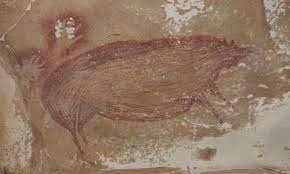
  • Scientists have discovered the world’s oldest-known confidently dated cave painting on the ceiling of a limestone cave in Sulawesi, Indonesia, depicting three human-like figures interacting with a wild pig, created at least 51,200 years ago, as per research published in Nature.
  • The researchers used a new scientific approach, involving a laser to date calcium carbonate crystals that formed naturally on top of the painting inside the Leang Karampuang cave in the Maros-Pangkep region.
  • The painting, dominated by a 92 cm by 38 cm pig figure alongside three smaller human-like figures, is painted in dark red pigment and is interpreted as a narrative scene, suggesting it is the oldest-known evidence of storytelling in art.
  • The deliberate positioning and interaction of the figures, indicate an unmistakable sense of action and storytelling.
  • The researchers also reassessed the age of another Sulawesi cave painting, depicting part-human, part-animal figures hunting pigs and dwarf buffalo, finding it to be at least 48,000 years old.

Dig Deeper: Where is India’s oldest cave painting located?

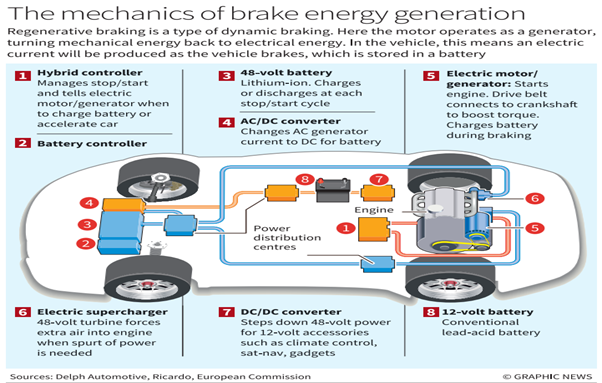
  • Electric vehicles, supported by state-led incentives and subsidies, exemplify sustainability, with regenerative braking being a key mechanism that increases energy efficiency.
  • In electric vehicles, a battery powers an electric motor (traction motor), which propels the vehicle.
  • Understanding Braking
  • Braking slows down a moving vehicle by removing kinetic energy, which must be transferred elsewhere due to the law of energy conservation. For example, disc brakes convert kinetic energy into heat through friction.
  • Regenerative braking converts the kinetic energy of a vehicle’s wheels into a storable form for future use.
  • Downsides of Regenerative Braking
  • Regenerative braking alone often can’t stop a vehicle completely and must be used with conventional brakes to dissipate kinetic energy as heat.
  • It also can’t prevent vehicles from backsliding downhill and recovers less energy as the vehicle slows down.
  • Despite these downsides, regenerative braking is beneficial for energy efficiency in stop-start traffic.

Dig Deeper: Read about Induction braking systems.