
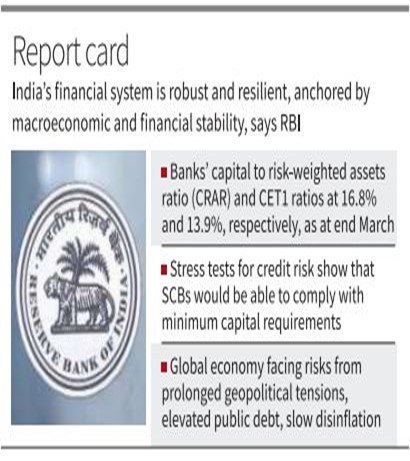
- The Indian economy and financial system remain robust and resilient, anchored by macroeconomic and financial stability, according to the Reserve Bank of India’s (RBI) 29th Financial Stability Report (FSR).
- The RBI highlighted that improved balance sheets of banks and financial institutions are supporting economic activity through sustained credit expansion.
- As of end-March 2024, scheduled commercial banks (SCBs) had a capital to risk-weighted assets ratio (CRAR) of 16.8% and a common equity tier 1 (CET1) ratio of 13.9%.
- SCBs’ gross non-performing assets (GNPA) ratio fell to a multi-year low of 2.8%, and the net non-performing assets (NNPA) ratio declined to 0.6%.
- Macro stress tests for credit risk indicate that SCBs will comply with minimum capital requirements, with the system-level CRAR projected at 16.1%, 14.4%, and 13.0% in March 2025 under baseline, medium, and severe stress scenarios, respectively.
- However, the RBI noted these are stringent conservative assessments under hypothetical shocks and should not be interpreted as forecasts.
- Non-banking financial companies (NBFCs) remained healthy, with a CRAR of 26.6%, a GNPA ratio of 4.0%, and a return on assets (RoA) of 3.3% as of end-March 2024.
- The RBI also noted that the global economy faces heightened risks from prolonged geopolitical tensions, elevated public debt, and slow progress in disinflation.
- Despite these challenges, the global financial system has remained resilient, and financial conditions are stable.
Dig Deeper: Know about India’s Fiscal deficit and Current Account Deficit numbers along with details of FRBM act.
