
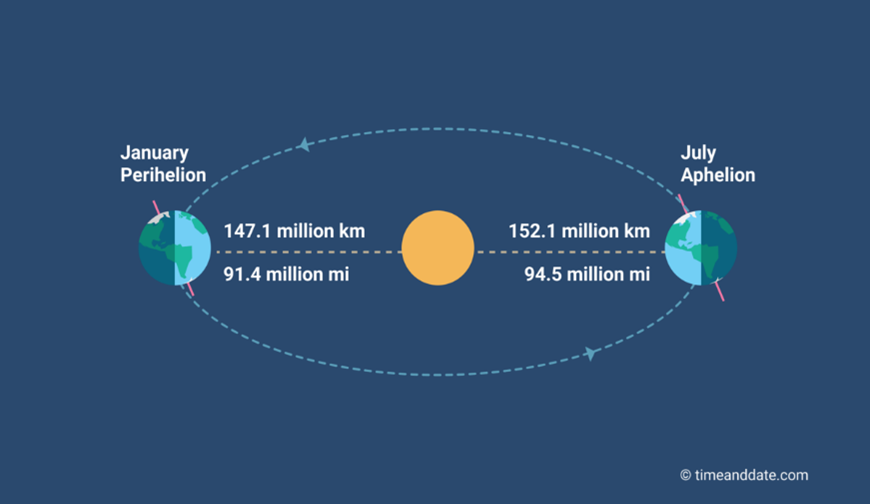
- Aphelion, the farthest point in Earth’s elliptical orbit around the sun, occurs annually in July.
- This year, it happened on July 5 at 1:06 a.m. Eastern time.
- Earth’s orbit, though primarily circular with an eccentricity of 0.017, varies slightly in distance, with Earth being about 94.5 million miles away from the sun at aphelion and approximately 91.5 million miles closer at perihelion in January.
- The concept of aphelion is significant because it marks a moment when Earth receives 7% less sunlight compared to perihelion.
- During aphelion, despite the reduced sunlight, the Northern Hemisphere experiences longer and hotter summer days due to its tilt towards the sun.
- Over long periods, Earth’s orbit is influenced by gravitational interactions with other planets, particularly Jupiter, which are gradually reducing its eccentricity, potentially leading to a more circular orbit in the future.
Dig Deeper: What do you understand by Eccentricity and Milankovitch Cycles?
