Search
Close this search box.

Heatwave in North India, China- Philippines conflict over Scarborough Shoal, The Story of Nalanda

Table of Contents
  • Northern India is experiencing the longest stretch of heatwaves in the past 15 years, with minimum daytime temperatures consistently above 45°C in some states.
  • Night temperatures are also 3°-6°C above normal due to a lack of moisture and rain.
  • The monsoon, which began early, has stalled since the second week of June in central India, the India Meteorological Department predicted normal rainfall for June but has since revised it to ‘below normal,’ indicating at least an 8% shortfall from the expected 16.69 cm.
  • The monsoon’s delay could extend the arrival dates over northwestern and northern states, typically between June 25 and July 1, further stressing infrastructure.

Dig Deeper: Which factors play a role in the break of Monsoon?
  • Prime Minister’s Economic Advisory Council (PMEAC) chairman made a case for revisiting India’s poverty line at a conference on the Household Consumption Expenditure Survey (HCES) 2022-23, hosted by the Ministry of Statistics and Programme Implementation (MoSPI).
  • He called the debate over the gap between survey findings and national income accounts as pointless.
  • India still lacks an official poverty line beyond the Tendulkar Committee’s 2009 recommendations, which set the poverty line at ₹33 per day in urban areas and ₹27 per day in rural areas.
  • While the Rangarajan Committee revisited the poverty threshold in 2014, its findings were never officially accepted.
  • The Multidimensional Poverty Index (MDPI) from the Niti Aayog, based on the National Family Health Survey, also does not serve as a poverty line.
  • PMEAC suggested that a new poverty line might be needed for the HCES data application, which addresses more than just inequality and poverty.
  • Inequality measured by the distribution of personal incomes, is slightly higher than that measured by consumption expenditure.

Dig Deeper: What is Gini Coefficient?

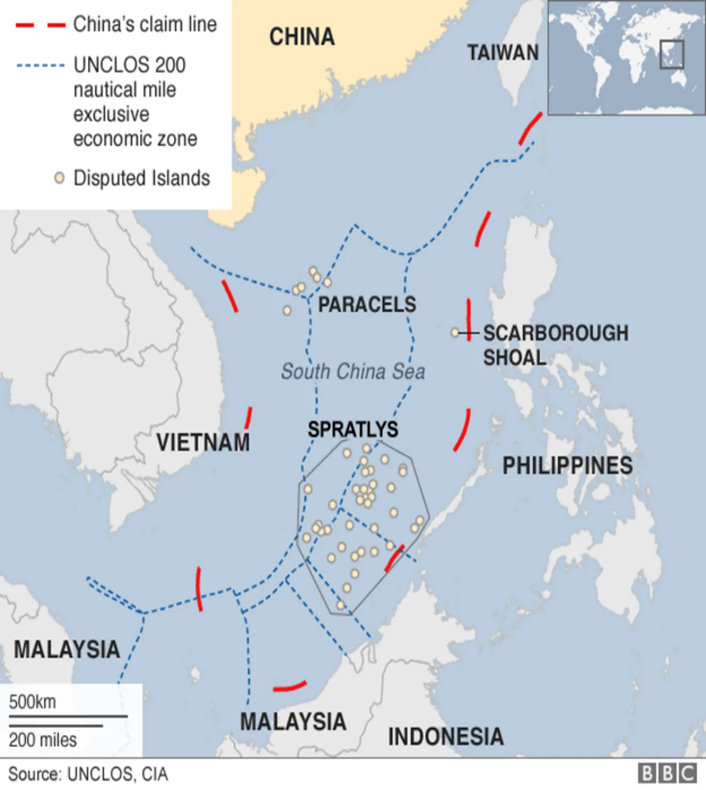
  • The Philippines initiated a transparency policy aimed at highlighting the conflict, involving ramming of ships, water cannon use, and diplomatic protests since the release of photos showing a military-grade laser China pointed at a Philippine ship in the South China Sea.
  • The South China Sea, rich in oil and gas, sees about $3 trillion in trade annually.
  • China, whose claims were invalidated by an international tribunal in 2016, accused Philippine vessels of illegal intrusion and warned the Philippines against misjudging the situation.
  • The conflict centres on Scarborough Shoal and Second Thomas Shoal, where the Philippine Navy maintains the BRP Sierra Madre (deliberately marooned on Second Thomas Shoal, in the Spratly Islands, since 1999,).
  • Both sides have traded accusations over maritime incidents, including a recent collision near Second Thomas Shoal.
  • The number of Chinese vessels around Second Thomas Shoal has increased significantly.
  • Last month, the Chinese coast guard seized supplies air-dropped to Philippine troops, escalating the standoff.

Dig Deeper: What is 9 dash line?

  • Australia is eager to conclude negotiations for the Comprehensive Economic Cooperation Agreement (CECA) with India soon due to domestic compulsions.
  • India may find it challenging to fast-track these talks, particularly in sensitive areas like agriculture, digital trade, and government procurement.
  • The India-Australia Economic Cooperation and Trade Agreement (ECTA), effective from December 29, 2022, serves as a foundation for CECA, which aims for a deeper, comprehensive agreement covering five tracks from ECTA: goods, services, digital trade, government procurement, and Rules of Origin.
  • New areas of interest include competition policy, MSMEs, gender, innovation, Agri-tech, critical minerals, and sports.
  • Australia seeks market access for premium items not competing with Indian domestic products.
India-Australia Economic Cooperation and Trade Agreement (ECTA)
Objectives– Strengthen economic ties between India and Australia, increase bilateral trade and investment, Enhance cooperation in various sectors
Key Features– Tariff reductions and eliminations on a wide range of goods, Facilitation of services trade, Strengthening of intellectual property rights
Goods CoveredAgricultural products, textiles, footwear, leather, gems and jewellery, pharmaceuticals, machinery, automobiles, and other industrial products
Services CoveredProfessional services, education, information technology, tourism, financial services, and other service sectors
Tariff Reductions– Immediate elimination or reduction of tariffs on over 85% of Australia’s exports to India, Gradual reduction of tariffs on remaining items over time
Market AccessImproved market access for Indian goods and services in Australia and vice versa

Dig Deeper: Read about countries with whom India has comprehensive economic agreements.

  • The Ganga River basin, India’s largest, reached a record low in snow persistence in 2024, according to the Hindu Kush Himalaya snow update by the International Centre for Integrated Mountain Development (ICIMOD).
  • The Brahmaputra and Indus basins also experienced significant declines, threatening water supply for millions.
  • Snow persistence refers to the fraction of time snow remains on the ground, providing essential water to people and ecosystems through snowmelt.
  • In the Hindu Kush Himalaya (HKH) region, snowmelt is a major water source, contributing 23% of the annual runoff to 12 major river basins.
  • The 2024 HKH snow update analysed data from 2003 to 2024, noting significant fluctuations in snow persistence from November to April.
BasinSnow Persistence Deviation from Normal (%)
Ganga River Basin17% below the historical average
Brahmaputra Basin14.6% below normal
Indus Basin23.3% below normal
Amu Darya Basin28.2% below normal
Helmand River Basin32% below normal
  • The primary reason for the lower snow persistence in 2024 was weak western disturbances, exacerbated by climate change and global warming.

Dig Deeper: Read about the critical ecosystem role of Snow leopards in the Hindu Kush Mountains region.

  • The story of revival of the ancient Nalanda University begins with the former President of India APJ Abdul Kalam, who officially made the revival proposal of the ancient university in 2006.
  • This was endorsed by the East Asia Summits in 2007 and 2009, with contributions from 17 countries including Australia, China, and South Korea.
  • The Bihar Assembly passed the University of Nalanda Bill in 2007, followed by the Nalanda University Bill in 2010, making it an institution of “national importance”.
  • It started admitting its first students in 2014 to the School of Historical Studies and School of Ecology and Environmental Studies.
  • It now includes additional schools such as the School of Buddhist Studies and the School of International Relations.
  • The campus blends modern and traditional elements, with smart classrooms, extensive green areas, water bodies, a yoga center, a library, and no cars allowed inside.

Nalanda

  • Nalanda Mahavihara, active from the 5th to 13th century CE, was one of the greatest centres of learning in antiquity.
  • The 7th-century Chinese traveller Hsuan Tsang documented Nalanda, noting it housed 10,000 students and 2,000 teachers, though this figure is disputed by scholars.
  • Nalanda was established during the Gupta Empire era (c. 3rd–6th century CE), and was supported by numerous Indian and Javanese patrons – both Buddhists and non-Buddhists
  • The administrative block recreates the brick architecture of the ancient Nalanda ruins. The campus incorporates natural cooling methods, extensive greenery, and water management systems.
  • Nalanda was not limited to Buddhist teachings; it also included Vedic, Hindu philosophy, logic, grammar, and medicine under its curriculum. Presently, the university aims to eventually accommodate 7,500 students and teachers.

Nalanda University’s revival symbolizes a blend of ancient heritage with modern educational standards, fostering international collaboration and sustainable practices. It continues to uphold its legacy as a premier centre of learning, both historically and in contemporary times.