
Concerns of Fisherman
- Fisherfolk of the two countries have been traditionally using the islet for fishing.
- Though this feature was acknowledged in the 1974 agreement, the supplemental pact in March 1976 made it clear that fishing vessels and fishermen of the two countries “shall not engage” in fishing in the historic waters, territorial sea and exclusive zone or exclusive economic zone of either of the countries “without the express permission of Sri Lanka or India.”
- St. Anthony’s Church there holds an annual festival, either in February or March, drawing devotees from both sides of the Palk Bay, a tradition which has been going on.
- Tamil Nadu Chief Minister rejected the claim of an agreement between the Union and State governments over ceding Katchatheevu to Sri Lanka.
- The Katchatheevu issue originated in 1974 from an understanding between the then Union and Tamil Nadu governments.
- Tamil Nadu government asserted that the State government was not properly consulted and that the Union government ceded the island to Sri Lanka, jeopardizing the rights and interests of Indian fishermen.
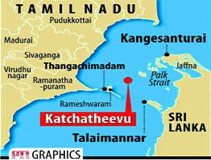
- Katchatheevu is a small strip of land spanning about 1.9 sq. km (0.7 so miles) and is located in the Palk Strait, which separates India and Sri Lanka.
- It lies northeast of Rameswaram in Tamil Nadu, India, and southwest of Jaffna, Sri Lanka and has no drinking water source.
- Since 1921, both India and Sri Lanka, claimed fishing rights in the waters around Katchatheevu.
- In June 1974, India formally exchanged agreement with her Sri Lankan counterpart ceding Katchatheevu to Sri Lanka.
Dig Deeper: Read about the Berubari case and dispute which involved the resemblance of the Katchatheevu case.
