
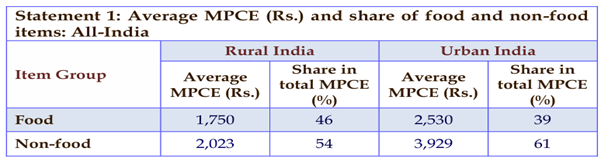
- A State Bank of India research report, based on the NSSO’s 2022-23 Survey on Household Consumption Expenditure (HCES), reveals significant trends in Monthly Per Capita Consumption Expenditure (MPCE) across India.
- Key Findings-
- There has been a nearly equivalent increase in MPCE across all fractile classes in both rural and urban areas over the past decade.
- The gap between the top and bottom fractiles in urban areas has sharply reduced.
- Enhanced connectivity, particularly through the construction of rural roads under PMGSY and their convergence with National Highways, is improving rural consumption patterns.
- Transformative measures like DBT transfers, PM Kisan, Ujjwala, MSP, eNAM, and AIF are bolstering rural infrastructure and contributing to a narrowing rural-urban MPCE gap.
- About 30% of rural MPCE growth is driven by endogenous factors.
- Persistent Disparities
- The top 5% of the rural population has an average MPCE of ₹10,501, about 7.6 times higher than the bottom 5% (₹1,373).
- In urban areas, this ratio is 10.4 times.
- Southern and northern states have nearly twice the average MPCE compared to eastern states.
- However, the eastern states show a slightly higher growth rate in rural areas, indicating potential for bridging the gap.
- The Northeast states exhibit the highest percentage of decadal growth, benefiting from the ‘Look North-East’ policy, which has improved the ease of business and living.
- There is a marked change in food habits across the country, with significant declines in rice consumption in the northeast and wheat consumption in the North and Central regions.
Dig Deeper: Read about various surveys conducted by NSSO and MoSPI.
