
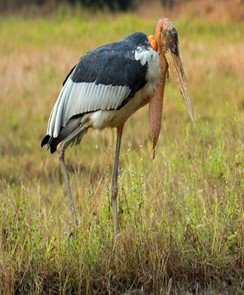
- The greater adjutant stork is one of the most majestic bird species. Its habitat in India is the Brahmaputra valley of Assam.
- The birds are found mostly in three districts of Assam — Guwahati, Morigaon, and Nagaon. The wetlands in and around Guwahati were home to these storks, which depended on them for food, water and shelter.
- The greater adjutant stork is shifted to near threatened from the earlier classification of endangered on the Red List of Threatened Species by the International Union for Conservation of Nature.
- Almost five feet tall are recently seen at a garbage dumping site near the Deepor Beel Wildlife Sanctuary, a Ramsar site.
- Between October and February period is the breeding season for the greater adjutant stork.
- Principally carnivorous, the greater adjutant stork preys on fish, frogs, snakes and other reptiles, eels, birds, and, also, carrion.
- Seasonally dependent on wetlands for foraging and tall trees for roosting and nesting, the storks suffer from the ongoing destruction of habitat through encroachment, overfishing and drainage projects.
- Though the species has received legal protection in India, in many areas, people drive out these birds as they may carry pieces of rotting meat to feed their hatchlings and because their droppings carry a strong odour.
Dig Deeper: Read about the Hargila Army working for the conservation of Greater Adjutant Stork.
