Search
Close this search box.

GDP Growth at 8.2%, Diversion of Forest land, Koya Tribe

Table of Contents
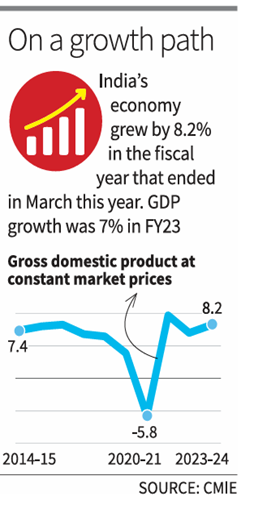
  • India’s real Gross Domestic Product (GDP) for FY24 is estimated to have grown by a faster-than-projected 8.2%, quickening from FY23’s 7% pace, the National Statistical Office’s (NSO) provisional estimates.
  • The NSO had in its first advance estimates projected real GDP growth for FY24 at 7.3%.
  • Nominal GDP has witnessed a growth rate of 9.6% in FY24 over the growth rate of 14.2% in FY23, the NSO said.
  • Real Gross Value Added (GVA) had likely expanded by 7.2% in FY24, faster than FY23’s 6.7%.
  • This GVA growth has been mainly due to significant growth of 9.9% in the manufacturing sector in FY24 over a 2.2% contraction in FY23, and mining and quarrying’s growth of 7.1% in FY24 over 1.9% in FY23, the NSO explained.
  • Real GVA and GDP growth in Q4 were estimated at 6.3% and 7.8%, respectively.
  • The divergence in GDP and GVA growth in Q3 has continued, with net taxes growing by 22% in Q4.
  • In the manufacturing sector GVA has recorded healthy growth supported by lower input cost, while robustness seen in the services sector has continued.
  • On the expenditure side of GDP, the growth has been mainly led by the government’s strong capex.

Dig Deeper: What is the difference between GVA and GDP?
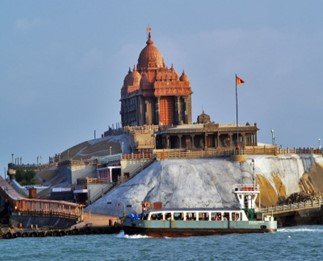
  • PM started his meditation at the Vivekananda Rock Memorial.
  • A 19th-century philosopher and author, Swami Vivekananda took India’s spiritual fame to the world at the Parliament of World’s Religions held in Chicago in 1893.
  • The rock on which the memorial is built is said to be where Vivekananda attained enlightenment.
  • The rock is surrounded by the Laccadive Sea where the Bay of Bengal, the Indian Ocean and the Arabian Sea form a confluence.
  • In honour of the great monk Vivekananda, the memorial was erected in 1970.
  • The memorial showcases an elegant blend of different architectural genres.
  • The Sripada Mandapam and Vivekananda Mandapam are two structures to be explored in the memorial.
  • There is also a life-sized bronze statue of Swami Vivekananda on the premises.
  • Legends also say that it was on this rock that Goddess Kanyakumari prayed to Lord Shiva, thus attaining an important place in India’s religious premises.
  • The ‘Devi Padam’, believed to be the footprint left by Bhagavathi Amman (Goddess Kanya Kumari) on the rock as she meditated in devotion to Lord Shiva.

Dig Deeper: Also read about the monument of the Thiruvalluvar located near the Vivekanand Rock Memorial.

  • The National Green Tribunal (NGT) has asked the Ministry of Environment, Forest and Climate Change to constitute a three-member committee to survey a part of a Geleki reserve forest of the Hailakandi district on the Assam-Nagaland border allegedly diverted for the establishment of an Assam police commando battalion.
  • This area is known for its rich biodiversity, including endangered species like the Hoolock gibbon, slow loris, and clouded leopard. The forest also serves as a crucial habitat for elephants, tigers, and a variety of birdlife.
  • Section 2 of the Forest (Conservation) Act, 1980 restricts de-reservation or non-forest use of forest land without prior approval from the Central Government.

National Green Tribunal

  • The National Green Tribunal (NGT) adjudicates cases of environmental protection and conservation of forests under the National Green Tribunal Act, 2010.
  • The NGT has jurisdiction over all civil cases under The Water (Prevention and Control of Pollution) Act, 1974, The Air (Prevention and Control of Pollution) Act, 1981, The Environment (Protection) Act, 1986, The Public Liability Insurance Act, 1991, The Forest (Conservation) Act, 1980 and The Biological Diversity Act, 2002
  • The Wildlife Protection Act of 1972 falls outside the jurisdiction of NGT.

Dig Deeper: Read about environmental issues of Northeast India over various development projects like Hydroelectric power plants.

  • The Enforcement Directorate (ED) has arrested individuals operating an international drug trafficking group- Singh DTO (Drug Trafficking Organisation)
  • They used vendor marketing sites on the dark web and numerous free advertisements on clear web websites.
  • A network of narcotics and controlled substance distributors and cells to sell drugs in the U.S., the U.K. and other European countries.
  • They used the moniker “Liston” on a variety of dark web markets, including Silk Road 1, Alpha Bay, and Hansa.
  • As per information, they received at least 8,088 bitcoins associated with the ‘Liston’ moniker.

Dark Web

  • US in the 1990s drove efforts to develop an anonymized and encrypted network.
  • This secret network would not be known or accessible to ordinary internet surfers.
  • Some of the researchers tweaked it to launch a nonprofit focused on anonymity for human rights and privacy activists.
  • The Tor network, short for “The Onion Router,” given the many layers of encryption that guard passing information.
  • Tor serves as the underlying technology of the dark web—a collection of hidden sites inaccessible via a regular browser and not indexed by search engines.
  • Today, over 65,000 unique URLs ending with .onion exist on the Tor network. The pairing of dark web services with cryptocurrencies has led to a boom in crime.

Dig Deeper: What is the difference between the Dark Web and the Deep Web?

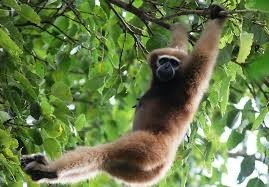
  • The Northeast Frontier Railway (NFR) has earmarked funds to construct canopy bridges for India’s only ape Hoolock Gibbon to move across a railway track bifurcating its prime habitat in eastern Assam’s Hollongapar Gibbon Sanctuary in Jorhat district.
  • The sanctuary has the largest concentration of the Hoolock gibbon, one of 20 species of apes on earth.
  • The Hoolock gibbon, a tailless ape known for its vocalisation, spends much of its time on the upper canopy of tall trees, mostly the hollong (Dipterocarpus macrocarpus).
  • IUCN red list categorises Hoolock Gibbons as Endangered.
  • Canopy bridges inside the sanctuary to facilitate the movement of the gibbons across the track.
  • These canopy bridges, designed by the WII in consultation with the NFR, will be constructed at identified points.
  • The ends of the canopy bridges, as well as the knots, will be secured and clamped or tightened using appropriate and high-grade fastening materials and techniques.
  • As a fail-safe mechanism, safety nets will be installed.
  • Lianas and creepers can be guided along them to look natural. The gibbons did not use the artificial bridge but used the natural canopy in past experiences.

Dig Deeper: Find out protected areas in which Hoolock Gibbons are in prominent numbers.

  • In the Godavari valley of Andhra Pradesh, the Koya tribe faces a cultural crisis as raids by the Special Enforcement Bureau, a newly-created police wing, threaten their cherished tradition of Mahua liquor consumption.
  • Scores of Koya women are increasingly abandoning their ancestral practice of collecting and brewing Mahua flowers, fearing the repercussions of enforcement actions.
  • The Andhra Pradesh Prohibition Act of 1995, did not exempt the brewing and storage of Mahua liquor by the Koya tribe.
  • The Panchayat (Extension to Scheduled Areas) Act (or PESA), 1996, empowers the gram sabha to protect the traditions, beliefs, and culture of the tribes.
  • Koya is one of the Particularly Vulnerable Tribal Groups.
  • The tribe now grapples with preserving its cultural identity amid increasing pressures from authorities
  • The Koya tribe is already in conflict over displacement by the Polavaram Irrigation Project from ancestral forests, the raids put further strain on our cultural lifestyle and practices.

Role of Mahua in Koya Culture

  • The Koyas begin their agricultural year with a three-day Bhumi Panduga, a monsoon festival complete with hunting and Mahua liquor. For the Koyas, consuming Mahua liquor offers relief during hunting expeditions.
  • The festival culminates in a community feast, signifying the beginning of the kharif season.
  • During Dasara, they observe Pachha Panduga, a festival centred around vegetables.
  • In Sankranthi, they celebrate Chikkudukai Panduga, in which all the newly harvested crops and Mahua liquor are offered to ancestors and deities before the people partake of it.

Dig Deeper: Read about the tribal rights under the Forest Rights Act, 2006.