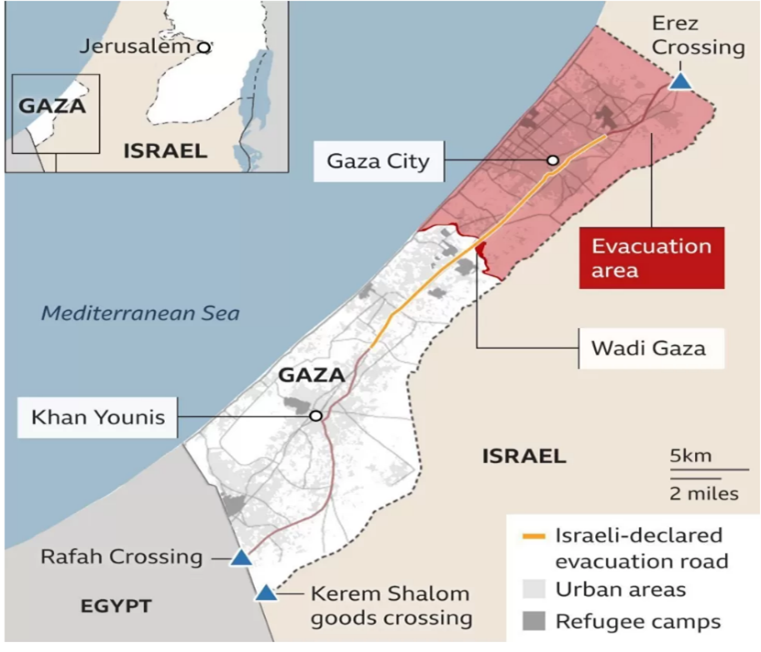
- The top UN court ordered Israel to halt military operations in Rafah immediately, a landmark ruling likely to increase mounting international pressure on Israel more than seven months into the Gaza war.
- The International Court of Justice (ICJ) also ruled Israel must keep open the key Rafah crossing for unhindered humanitarian aid and urged the unconditional release of hostages taken by Hamas during its October 7 assault.
- ICJ rulings are legally binding but the court has no concrete means to enforce them. For example, it ordered Russia to halt its invasion of Ukraine, to no avail.
| International Court of Justice (ICJ) The principal judicial organ of the United Nations (UN). The ICJ was established in 1945. All members of the UN are parties to the statute of the ICJ, and nonmembers may also become parties. The ICJ is a continuing and autonomous body that is permanently in session.The seat of the ICJ is at The Hague, but sessions may be held elsewhere. The official languages of the court are French and English.The court’s primary function is to pass judgment upon disputes between sovereign states. Only states may be parties in cases before the court, and no state can be sued before the World Court unless it consents to such an action. |
South Africa brought the case before the ICJ last year alleging that Israel’s Gaza offensive breached the 1948 UN Genocide Convention — a charge strongly denied by Israel.
- The ICJ ordered Israel to do everything it could to prevent acts of genocide during its military operation in Gaza.
- The ICJ also ordered Israel to ensure unimpeded access to UN-mandated investigators to look into allegations of genocide.
Dig Deeper: Compare the mandate of ICJ and ICC.