Search
Close this search box.

Daily Current Affairs Prelims 18 May 2024

Table of Contents
  • Spain has refused entry to a Denmark-fagged cargo ship Marianne Danica carrying arms from Chennai to the port of Haifa in Israel.
  • Spain has been extremely critical of civilian casualties in Gaza and, along with Belgium, has suspended arms export licences to Tel Aviv.
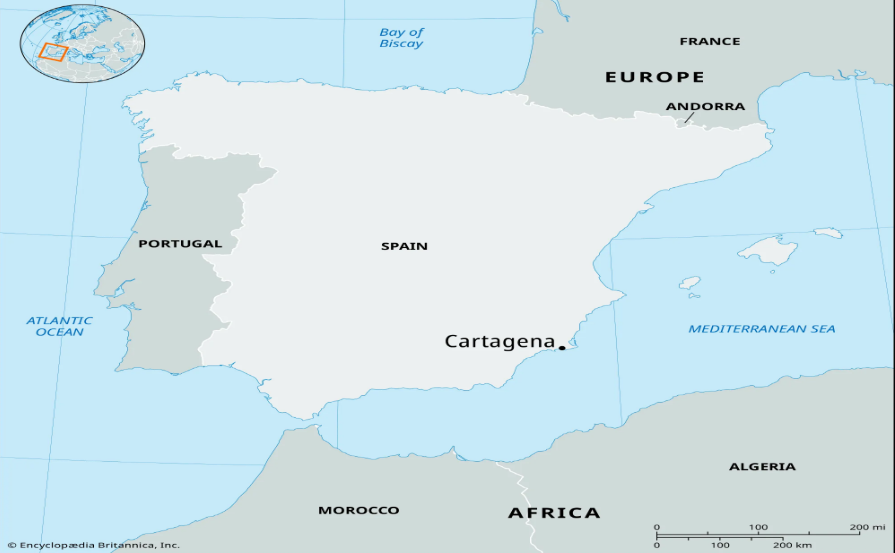
  • It was to make a port call at Cartegena in Spain.
  • Cartagena is the Mediterranean Port of Spain located east of the Strait of Gibraltar.
  • The Strait of Gibraltar lies between the southernmost tip of Spain and the northern tip of Morocco.
  • At the northeastern edge of the Strait is the territory of Gibraltar, which is governed by the United Kingdom.
  • The Strait of Gibraltar connects the Mediterranean Sea with the Atlantic Ocean.
  • The strategic location near the East-West maritime route linking the Suez Canal to the Strait of Gibraltar
  • It is 36 miles (58 km) long and narrows to 8 miles (13 km) in width between Point Marroquí (Spain) and Point Cires (Morocco).
Dig Deeper: Read about the role of UNCLOS in maintaining freedom of Navigation in critical passages of maritime trade.

  • The Association for Democratic Reforms petitioned in Supreme Court that there was an unusually sharp spike in figures from the initial voter turnout percentages released by the poll panel, raising doubts about the authenticity of the polling data available in the public domain.
  • The Supreme Court orally asked the Election Commission (EC) to explain its inability to immediately upload on its website authenticated, scanned and legible accounts of votes recorded booth-wise after each phase of polling in Lok Sabha elections.
  • Rule 49S and Rule 56C (2) of the Conduct of Election Rules, 1961 require the Presiding Officer to prepare an account of votes recorded in Form 17C (Part I) format.

Dig Deeper: Read about various rules of the Conduct of Election Rules, 1961 which are in discussion.

  • In a mere three years, from 2019 to 2022, India may have lost close to 5.8 million full-grown trees in agricultural lands, says a satellite-imagery-based analysis by researchers at the University of Copenhagen, Denmark, published this week in the peer-reviewed journal Nature Sustainability.
  • Additionally, 11% of such trees detected via satellite during 2010-2011 were no longer visible when reviewed from 2018 to 2022, leading the researchers to conclude that these trees had disappeared.
Satellite Based DataThe researchers combined satellite imagery from two repositories — RapidEye and PlanetScope to estimate changes in tree numbers from 2010 to 2022. These have resolutions of three to five metres, meaning that the satellite can see large trees, three to five metres apart, as individual trees. The FSI relies on data from the Sentinel satellite that has a coarser resolution of 10 metres — implying that they can tell apart blocks of trees but not individual ones. 
  • This does not necessarily imply that India’s overall tree cover, or trees outside the forest, is declining as the analysis was specific to only large trees above a certain size.
  • The Forest Survey of India (FSI) conducts regular surveys of tree cover (both inside and outside forests) but only publishes data on the changes in acreage and not individual trees.
  • The latest FSI report says that India’s tree cover has increased in 2021 over 2019.
  • About 56% of India is covered by farmland and 22% by forest.
  • With the largest agricultural area in the world, changes in tree cover here, while critical, have been largely overlooked.

Dig Deeper: Read about the quality of forests debate in India.

  • The soaring prices of coffee beans, driven by a global shortage in crop production, have provided a ray of hope for coffee growers in Karnataka, which is the highest coffee-growing State in India.
  • Dry conditions in Vietnam and Ethiopia have impacted global production.
  • Farmers grow both Robusta and Arabica varieties in India. Chikkamagaluru, Kodagu, and Hassan are the coffee production districts of Karnataka.
  • Arabica is considered a more premium segment variety however recently prices of Robusta even shot up exceeding Arabica’s price level.
The saga of Indian coffee began on a humble note, with the planting of ‘Seven seeds’ of ‘Mocha’ during 1600 AD by the legendary holy saint Baba Budan, in Baba Budan Giri hills of KarnatakaCoffee in India is grown under a canopy of thick natural shade in ecologically sensitive regions of the Western and Eastern Ghats. 

According to the Coffee Board of India, the total production of coffee in India during the 2022-23 fiscal was 3,52,000 tonnes (around 3 to 3.5% of global production), including 2,52,000 tonnes of Robusta coffee.

  • The total value of India’s coffee exports has risen to ₹5,279 crore during the ongoing coffee season, from ₹3,982 crore during the same period in the earlier season.
  • Coffee plantations are not covered under crop insurance.
Coffee Board and PoliciesThe Coffee Board is a statutory organization constituted under Section (4) of the Coffee Act, 1942.It functions under the administrative control of the Ministry of Commerce and Industry, Government of India. The Board comprises 33 Members including the Chairperson. The Board is mainly focusing its activities in the areas of research, extension, development, market intelligence, external & internal promotion and welfare measures. The Board has a Central Coffee Research Institute at Balehonnur (Karnataka)Before the introduction of the free-sale quota (FSQ) for coffee in 1992, growers had to sell their entire harvest to the Coffee Board.

The compensation paid during a drought or flood is negligible considering the investment made by the growers amidst cycles of drought, flood, and landslides.

Dig Deeper: Read about the impact of Climate Change on the global production and prices of coffee and Chocolate.

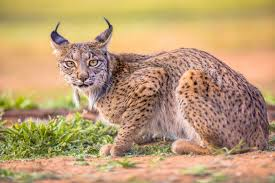
  • The number of endangered Iberian lynx in the wild in Spain and Portugal has nearly doubled since 2020 to surpass 2,000 last year, according to the Spanish government.
  • A total of 722 lynx were born in 2023 bringing their total number in the two countries to 2,021.
  • The boom in lynx numbers is attributed to the success of a captive breeding and reintroduction programme launched in 2011.
  • A new ambitious conservation project, LIFE Iberlince, is recovering some of the lynx’s lost territories in Spain and Portugal.
  • This rise allows the reduction of the risk of extinction of the Iberian lynx.
  • The Iberian lynx was on the brink of extinction just two decades ago due to poaching, road accidents, as well as a dramatic decline due to disease in wild rabbit numbers, the lynx’s main prey.
  • The Iberian lynx is known for its pointy ears, long legs and leopard-like spotted fur.
  • The Iberian lynx mostly depends on wild rabbits to feed, but it will also eat ducks, young deer and partridges if rabbit densities are low.
  • The Iberian lynx population has continued to rise since 2015 when the International Union for Conservation of Nature downgraded the threat level to ‘endangered’ from ‘critically endangered’ — its highest category before extinction in the wild.

Dig Deeper: Compare reintroduction and captive breeding of Iberian lynx with Project

Cheetah of India.