Search
Close this search box.

Registration of Political Party with ECI, Right to Private Property, Ganga Jatara

Table of Contents
  • In its judgment in the case of Tarsem Lal versus the ED, challenging a Punjab and Haryana High Court decision that denied him anticipatory bail, the Supreme Court limits the power of the ED to arrest individuals accused under the PMLA.
The twin conditions of bail under Section 45 of the PMLAThe person has to prove in court that he or she is prima facie innocent of the offence. The accused should be able to convince the judge he would not commit any offence while on bail.

An accused is presumed to be not in custody if he appears in court on a summons. It gives a fillip to the right to personal liberty of a person.

  • If an accused does not appear after a summons is served, the special court could issue a bailable warrant followed by a non-bailable one.
  • ED would have to separately apply for custody of a person who appears in court.
Stringent provisions of the Prevention of Money Laundering Act, 2002Power to Arrest (Section 19): Authority to arrest individuals based on mere suspicion of involvement in money laundering, without the need for a warrant.Burden of Proof (Section 24): The onus of proving innocence lies on the accused, reversing the general principle of ‘innocent until proven guilty.’Attachment of Property (Section 5): ED can provisionally attach properties suspected of money laundering for up to 180 days, even before conviction.Powers to Summon and Question (Section 50): ED has the authority to summon individuals for questioning and require them to produce documents. 

ED may arrest a person not shown as an accused in the complaint filed under Section 44(1)(b) of the PMLA, provided the requirements of Section 19 (procedures of arrest) under the Act were fulfilled.

Dig Deeper: Read about the role of the Enforcement Directorate beyond PMLA.
  • The Thathayagunta Gangamma temple, situated in the heart of the temple city of Tirupati, celebrates the annual folk festival ‘Ganga Jatara’.
  • It is for the first time in the history of the centuries-old temple that the annual folk festival was postponed due to the elections.
  • The folk festival is meant to appease the ‘Grama Devatha’ (village deity).
  • The nine-day event comprises devotees donning various guises, smearing colours all over their bodies, and staging processions on the streets around the temple.
  • Women carrying the statuettes of ‘Nava Durgas’ accompanied the entourage, adding spiritual fervour to the procession.
  • The Goddess is revered as the younger sister of Lord Venkateswara, and the natives of Tirupati, believe that She is the bestower of fortunes and conduct this annual festival.

Dig Deeper: Get an overview of popular temple festivals of South India.

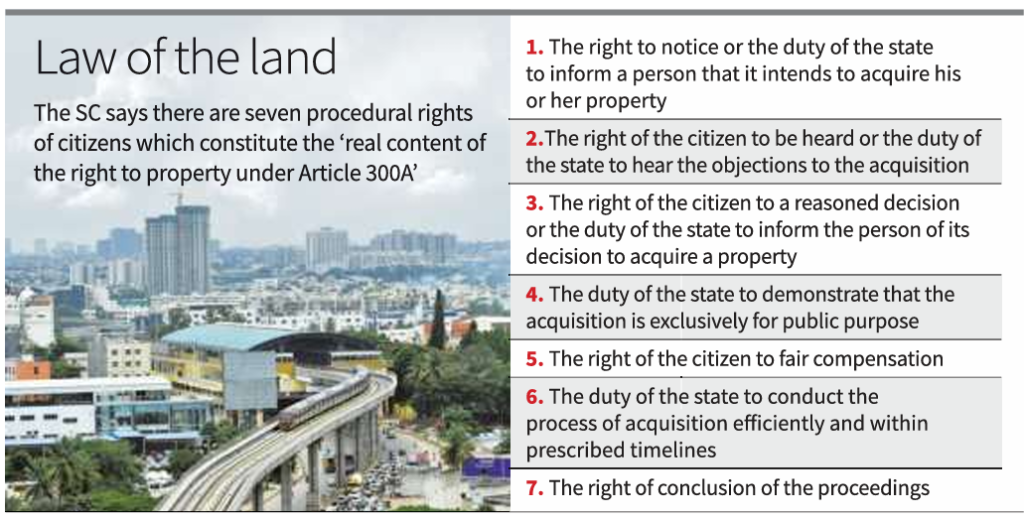
  • The Supreme Court judgment upheld a Calcutta High Court order rejecting an appeal filed by the Kolkata Municipal Corporation defending its acquisition of private land.
  • It is generally assumed that for a valid acquisition, all that is necessary is to possess the power of eminent domain [power of the sovereign to acquire property of an individual for public use without consent] to acquire, followed by the grant of reasonable and fair compensation.
  • Compulsory acquisition will still be unconstitutional if proper procedure is not established and followed before depriving a person of his/her right to property.
  • Though the 44th Constitutional Amendment omitted the right to property as a fundamental right, Article 300A, which was simultaneously inserted into the Constitution, provided that “no person shall be deprived of his property, save by authority of law”.
  • The right to property has even been interpreted to be a human right.

Dig Deeper: Read important provisions of Right to Fair Compensation and Transparency in Land Acquisition, Rehabilitation and Resettlement Act – 2013.

  • Adolescent girls and those with comorbidities are at a higher risk of adverse events after receiving Bharat Biotech’s BBV152 (Covaxin) vaccine against COVID-19, according to a report published in Springer Nature recently.
  • Nearly a third of the participants of an observational study on the vaccine reported adverse events of special interest (AESI).
  • The one-year follow-up study titled ‘Long-term safety analysis of the BBV152 coronavirus vaccine in adolescents and adults: Findings from a one-year prospective study in North India’, was conducted by a team of researchers at Banaras Hindu University.
  • Serious adverse events may occur in 1% of BBV152 recipients, and extended surveillance is warranted following the administration of the vaccine.
Bharat Biotech emphasised the need for comprehensive unbiased safety studies AESI safety profile of the subjects prior to their participation. A comparison of the safety profile of non-vaccinated subjects. Comparison of the safety profile of subjects who received other vaccines. All study participants should be followed during the course instead of subset.   

According to the study, Viral upper respiratory tract infections were reported by 304 (47.9%) adolescents, new onset skin and subcutaneous disorders (10.5%), general disorders (10.2%), and nervous system disorders (4.7%) were the common AESIs in adolescents.

  • Menstrual abnormalities were noticed in 4.6% of female participants. Ocular abnormalities and hypothyroidism were observed in 2.7% and 0.6% of the participants, respectively.
  • Among the serious AESIs (1%), stroke and Guillain-Barre syndrome were identified in 0.3% and 0.1% of the participants, respectively.
Pandemic of Covid-19 and VaccinesViral vector and mRNA-based COVID-19 vaccines were distributed on a large scale, worldwide.In India, the BBV152 was the only vaccine that was initially granted permission for mass roll-out in adolescents in the 15-18 years age group. The short-term safety of COVID-19 vaccines approved for adolescents was shown to be favourable in controlled settings. 

Dig Deeper: Read concerns raised by various safety studies of different vaccines and comparative analysis.

  • Recent study published in Women’s Reproductive Health as ‘Reported Reasons for Undertaking Hysterectomy Among the Women Aged 45 Years and Above: Evidence from Longitudinal Aging Study in India (LASI) Wave-1 (2017–2018) ‘.
  • Removal of the uterus or hysterectomy is one of the most frequently conducted surgeries among women globally.
  • It is considered a major surgery, though advances in technology now allow for minimally-invasive removal of the uterus too.
Hysterectomy comes with ramificationsThis includes early menopause, risk of cardiovascular disease, urinary incontinence, obesity, endocrine and metabolic complications, and loss of sexual desire. Estrogenic decline also impacts bone density loss, vasomotor symptoms, frailty, depression, and a decline in cognitive function. 

Common causes for doing a hysterectomy:

  1. Majorly due to fibroids (47.6%), uterovaginal prolapse (13.4%), benign ovarian cysts (12%), malignancy (9%), and adenomyosis (6%).
  2. Sometimes for removal of other parts of the female reproductive system, such as the ovary, fallopian tubes, and cervix.
  3. The surgery is done, when all else fails, to alleviate symptoms of gynaecological disorders — irregular bleeding, menorrhagia, pelvic pain, and bodily discomfort.
  4. It can also reduce anxiety and depression in women, enhancing their quality of life according to many studies.
  5. The Union Ministry of Health and Family Welfare issued guidelines last year to prevent unnecessary hysterectomies.
  6. There are rising hysterectomy rates among young women, ranging from 28 to 36 years in India.
  7. There are unnecessary hysterectomies performed in cases where medical or non-invasive treatment would have been sufficient.
  8. Reports of potential coercion for financial benefit under health insurance schemes and concerns about a lack of information provided to women on side effects.
  9. According to NFHS-5 (2019-2021), 3.3% of women in the age group of 15-49 years had a hysterectomy. The study shows that 50% of the women got these surgeries before attaining age 35.
  10. The average prevalence rate of hysterectomy is estimated to be 17 per 1,000 among ever-married women between the ages of 15-49 years.

Dig Deeper: Read Union Ministry of Health and Family Welfare guidelines for hysterectomy.

  • The Election Commission of India (ECI) in its report on enforcing the Model Code of Conduct (MCC) has stated that it expects star campaigners to lead by example and not vitiate the fabric of society. This has raised a debate about ECI’s powers to rein in MCC violations.
Section 29A of the Representation of the People Act, 1951 (RP Act) lays down the following requirements for registration of a political party with the ECI –Any political party that seeks registration should submit a copy of its memorandum/constitution. Such document should declare that the party shall bear true faith and allegiance to the Constitution of India. It should also bear allegiance to the principles of socialism, secularism and democracy, and uphold India’s sovereignty, unity and integrity.

A registered party is referred to as a Registered Unrecognised Political Party (RUPP).

  • Political parties are recognised as a ‘national’ or ‘State’ party under the provisions of The Election Symbols (Reservation and Allotment) Order, 1968 (Symbols Order) by the ECI.
  • The Representation of Peoples Act does not confer explicit powers on the ECI to de-register any political party if it fails to contest elections, conduct inner-party elections or lodge requisite returns.
Registered political parties enjoy the following legal benefitsTax exemption for donations received under Section 13A of the Income Tax Act, 1961.Common symbol for contesting general elections to the Lok Sabha/State AssembliesTwenty ‘star campaigners’ during an election campaign. As per the ECI, there are 2,790 active registered political parties in India. 

The Supreme Court in the Indian National Congress versus Institute of Social Welfare & Ors (2002) had held that the ECI does not have the power to de-register any political party under the Representation of Peoples Act.

  • It may de-register only under exceptional circumstances like registration being obtained by fraud or the political party ceasing to have allegiance to the Constitution or if it is declared unlawful by the Government.
  • Under Paragraph 16A of the Symbols order, the ECI has the power to suspend or withdraw recognition (National or state) of a recognised political party for its failure to observe MCC or follow lawful directions of the Commission.
  • It has probably been used only once for three weeks in 2015 when the recognition of the National People’s Party was suspended for failure to follow the directions of the ECI.

Dig Deeper: Read about the powers of the Election Commission of India to take action against violators of the Model Code of Conduct.